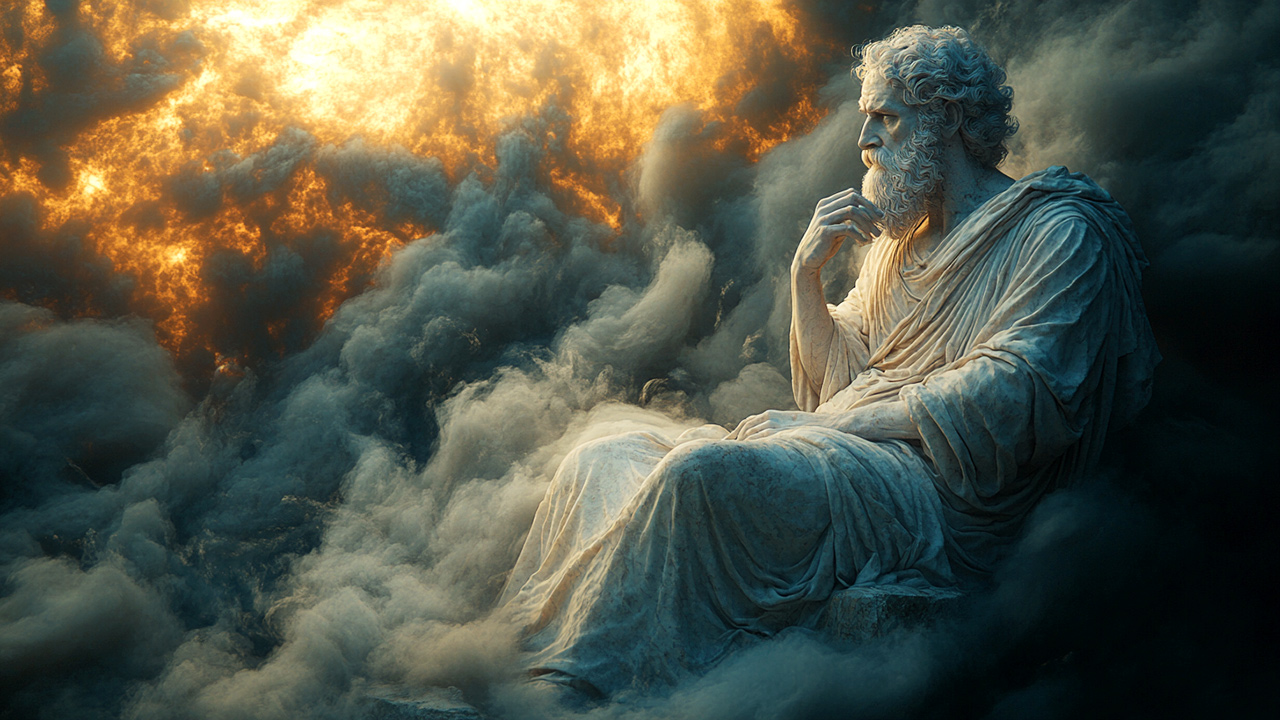
Anaxagoras and Societal Nous
Anaxagoras developed a vision of matter that can deeply impact our own understanding of societal frameworks. He wrote that within each part of matter in the material world, there was potential for all other parts. Each bit of matter was infinitely divisible, and could become anything based on the bidding of the Nous. This Nous was an ordering force completely separate from matter yet simultaneously painfully immanent in how it rearranged the world. For an amount of matter to be what we call a piece of gold, gold would have to be the dominant nature, which was decided by Anaxagoras’s ordering force. The material used to create anything, even when in actuality a single item, still contained potentiality for any form of matter. At any given time the Nous determined the form which matter took. All the while, matter remained full of its inherent and infinite potential. When this framework of potentiality and actuality is applied to human action, it can help understand how unlimited human potential is siloed into a smaller set of predominant outcomes. Culture and government are functionally external forces imposed upon people in the present by those who created them in the past. While this is not true in a strict philosophical sense, functionally we are formed by, and live within, a world shaped by structures outside our control. This inability to initially shape ourselves or quickly change our circumstances emphasizes our responsibility to shape institutions and culture to the benefit of those that come after us.
Every human contains infinitely indivisible potential for both good and evil. The great atrocities of the 20th century and the selfless sacrifices of those who resisted stand as clear examples of the vast variation possible in human nature. People are not constrained to any specific set of outcomes, but rather possess a touch of the infinite in a world of finite materiality. Although embodied and material beings, each person has infinite potential actions at their fingertips. While both matter and humans are inherently finite and limited, their possession of the infinite in potentiality gives great power to whichever forces control them. People are not able to do whatever they wish, but along the axis from good to evil every individual has almost unlimited choice even within the bounds of any physical constraint. While some may have access to far more resources than others, the boundaries of self-sacrifice and hatred are free to be pushed by anyone. While few will act in a uniquely good or evil way, every person has the potential to reach either the depths or heights of human action. To be clear, the possession of this potential does not mean that it is practically possible, but rather that it cannot be ruled out theoretically.
While the range of possibilities from good to evil is infinite, each person and group of people expresses a dominant nature. Far from being strictly a result of their own choices, the dominant nature is determined by societal and governmental principles analogously to the Nous. While society and government are not strictly exogenous as the Nous of Anaxagoras was, it is functionally exogenous for each individual. The cultural and governmental constraints of each society push them towards a different dominant nature. The gap between infinite potentiality and limited actuality, is bridged by a government and institutional setting created by those of the prior generation. While in some cases, a current generation can have vast institutional and cultural effects, the stickiness of institutions and culture means that for most of human history, people have primarily been recipients of institutions handed to them by those in prior generations.
Rather than a cause for despair, this should leave us in awe of the great burden of creation we bear for the next generation, along with thanks for those who came before. While we see the clear gaps left by the generations before us, we must be first thankful for how they restructured the world in ways they would never benefit. While constrained by the institutions of those who came before them, they laboured with little return for countless things we would only recognize the worth of if they were absent. We must orient our action towards this great responsibility by thinking in terms of long-term structure rather than immediate outcome. If a rate cut and the associated loss in credibility of the Fed is supposed to make the market better, we must ask, “for who?” “For how long?” “How will this change the Nous of the next generation?” We make decisions that set new norms and determine the likeliest manifestation of humanity’s limitless potential. While not a perfect ordering force like Anaxagoras’ Nous, government and culture can greatly shift probabilities toward or away from evil. We must recognize this power and set norms for the next generation that reward selflessness, responsibility, and hard work, and thus give them a higher chance of a better dominant nature than ours.

Receive SchiffGold’s key news stories in your inbox every week – click here – for a free subscription to his exclusive weekly email updates. Interested in learning how to buy gold and buy silver? Call 1-888-GOLD-160 and speak with a Precious Metals Specialist today!
 Live Chat
 Email:
  Phone: 1-888-465-3160