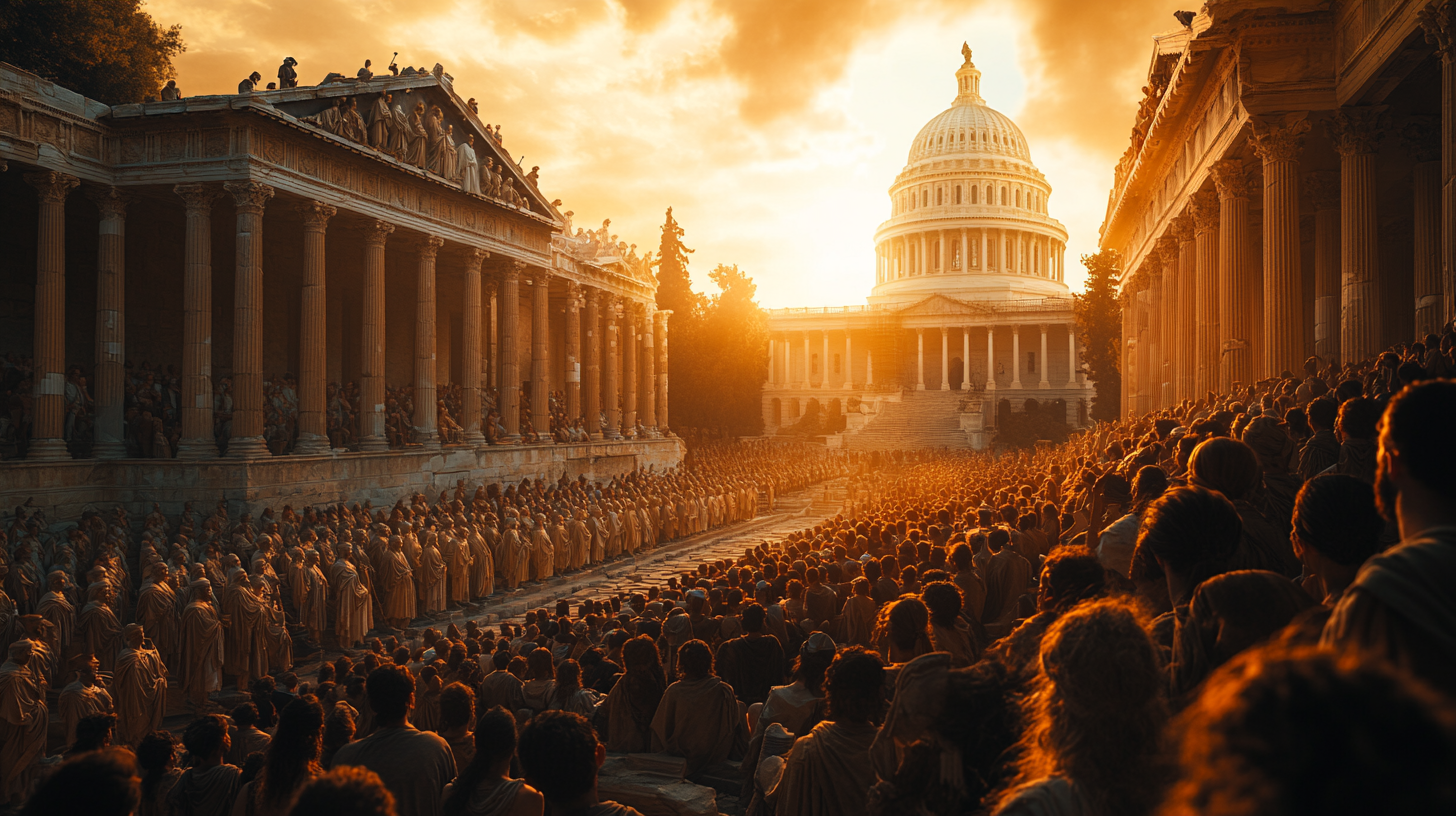
Democracy Was Not Meant For Us
Democracy truly was not meant for us. Democracy was built for people that are so different from us that they would hardly recognize us or the form of government we have built on democratic principles. Democracy was meant to be governance of all by the free. In our society, except for circumstances of age or incarceration, all are free, and thus we all have the right to govern. While nearly everyone has the right to vote, we have some key differences from the classical Athens in which democracy was created that we must recognize to understand the future of our government. Athens only had roughly 300,000 citizens, and only 50,000 of them were eligible to vote. The Athenian assembly directly voted on issues rather than using representation. While far from monolithic, Athenian culture at the time had far more commonality in belief and aim than ours today, and thus we need a modified form of democracy. All the benefits of democracy can only be accessed when we recognize that it cannot work the same way in every situation. Our constitution and slower legislative processes protect our country from the potential damage of utilizing democracy in a situation different from the one in which it was created.
The vast difference in size of Athens and America forces us to answer some obvious questions. Unity was already hard enough for a culturally similar and relatively small group of Athenians, even when only letting free men vote. America is home to nearly 350 million people. The cost of information coordination between all of these people is much higher than it was for the Athenians, even given our technological advantages. There simply was not as much information to spread, and as such the smaller population had a larger base of shared understanding of the cosmos. Our nation has hundreds of millions of people who can vote, and even if they all wanted the same thing, it would be nearly impossible to organize them towards some vision of the common good. Is democracy really the same thing when it is practiced at such a large scale? Would the Athenians have supported democracy for a country of our size? If not for the advantage in national defense and trade, would it really be best for this many different city states to be attempting democracy with one another? None of these questions have a clear answer, but understanding the historical roots of democracy allows us to evaluate objectively rather than accept democracy as we practice it as a truth dropped onto us from the heavens.
The creation of career politicians through the necessity of representation is one of the greatest risks that the Athenian government attempted to avoid. They had an entire process of ostracization to get rid of anyone who had potential for tyranny. The Athenians did not want any one individual to have a whole life spent in the political sphere. Some of the worst products of the Athenian experiment were people who did just that, such as Alcibiades. Our nation is so large that we do not have the luxury of voting directly as the Athenians did. We have far less say in our own governance, both in the ability to change the opinions of fellow citizens, the potency of our vote, and the way the mandate of our vote is used after we have cast it. Direct representation cuts out the middleman, and in the case of America, our middlemen have fallen into predictable suboptimal paths due to strong negative incentives. The constant promises and broken promises of the election cycle are almost a necessary feature of the representative democratic system. Once in office, those in office have far less motivation to disrupt the status quo then the citizen with nothing to lose. This is good for stability but bad for the power of representation. There is almost no practical way for direct representation, but countless side effects of indirect representation should make us wonder if there is a better way.
Our nation is far more fragmented and differentiated than Athenian culture, both as a function of size and cultural diversity. Our culture began by holding in tension a wide range of religious diversity, and that tension has only grown as our dimensions of diversity have increased. America encompasses nearly every different culture and belief that could be imagined, and we want to find political stability. Not everyone can have their way and our diversity of vision for an optimal national end state means that hundreds of millions of people will always be unhappy. Democracy isn’t easy when people have a shared background and values, but it becomes almost impossible when backgrounds do not become subordinated to some moral code or national identity. We can make diversity of background and culture work, but we must more explicitly name and promote American values if we are to create a democracy with the best of the things that the Athenians would have recognized.

Receive SchiffGold’s key news stories in your inbox every week – click here – for a free subscription to his exclusive weekly email updates. Interested in learning how to buy gold and buy silver? Call 1-888-GOLD-160 and speak with a Precious Metals Specialist today!
 Live Chat
 Email:
  Phone: 1-888-465-3160