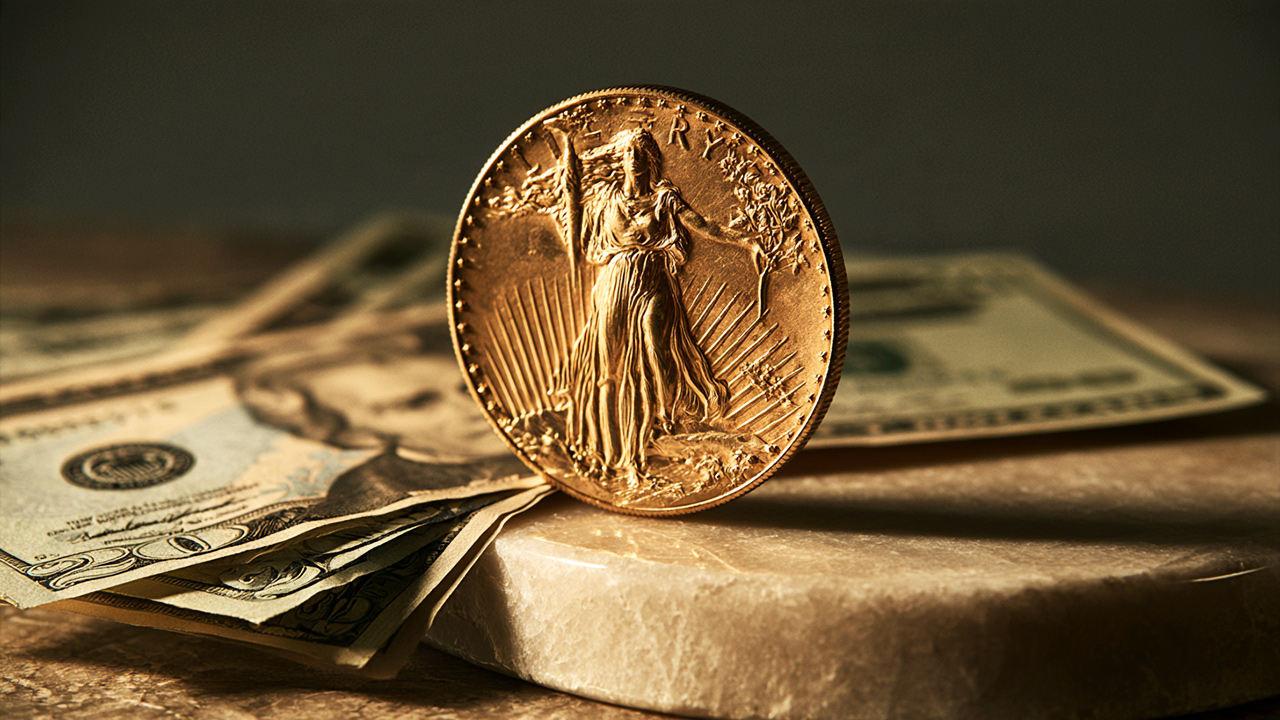
The 20$ Double Eagle
When a $20 Gold Coin Became Worth Thousands of Dollars
Imagine finding a $20 coin in your grandfather’s collection.
Not a twenty-dollar bill. An actual gold coin, stamped with the words “Twenty Dollars” and issued by the United States government.
You might assume it’s worth a little more than $20 because it’s old. That would be an underestimation.
A traditional American Double Eagle contains approximately 0.9675 troy ounces of pure gold. At a hypothetical gold price of $4,000 per ounce, the metal alone would be worth about $3,870.
And that’s before considering any collectible value.
The coin still says $20.
So what happened?
Did the gold become more valuable, or did the dollar become worth less?
The answer is more complicated than either explanation alone.
When Twenty Dollars Meant Gold
The Double Eagle emerged during the California Gold Rush, when new discoveries dramatically increased the supply of gold entering the American economy.
Congress authorized the $20 gold denomination in 1849, and regular production began in 1850.
The coin was substantial, containing nearly an ounce of pure gold. It wasn’t a novelty or a commemorative piece. It was money. For Americans accustomed to today’s paper currency and digital payments, that distinction can be difficult to appreciate. The denomination on the coin was connected to a legally defined quantity of gold.
The U.S. Mint’s history of American gold coins traces the development of these denominations, while SchiffGold’s Double Eagle listing illustrates how the historic coins are valued in today’s bullion market.
A Double Eagle’s gold content hasn’t changed since it left the Mint. The number of dollars required to purchase that gold certainly has.
The Most Beautiful Coin America Ever Made?
In 1907, President Theodore Roosevelt helped bring about a redesign of American gold coinage. Sculptor Augustus Saint-Gaudens created a Double Eagle featuring Liberty striding forward with a torch and olive branch. The design became one of the most celebrated in American coinage.
The U.S. Mint’s account of the Saint-Gaudens Double Eagle describes the collaboration and the artistic ambitions behind the coin. But the Double Eagle’s story would soon become about much more than artistic design. The Great Depression transformed the relationship between Americans, their money, and gold.
The Gold Coin That Outlived the Gold Standard
In 1933, President Franklin Roosevelt’s administration restricted private monetary gold holdings and ended ordinary gold-coin circulation.
The government subsequently changed the official gold price from approximately $20.67 to $35 per ounce in 1934. That was a major monetary shift. Gold hadn’t suddenly become heavier or more useful. The government had changed the dollar’s official relationship to the metal.
SchiffGold’s account of the 1933 monetary changes presents those decisions as a turning point in the dollar’s history.
The restrictions also produced one of the strangest episodes in American coin collecting. The Philadelphia Mint struck hundreds of thousands of 1933 Double Eagles, but they were never officially released into ordinary circulation.
Most were melted, a handful survived, leading to decades of legal disputes and extraordinary auction prices.
The U.S. Mint documented the recovery of ten such coins, part of a remarkable story involving collectors, the government, and questions of ownership.
Peter Schiff has also examined the distinction between bullion and collectible coins in The Confiscation Con, cautioning against paying excessive premiums based on claims about special legal protections.
A Twenty-Dollar Coin Worth Millions
One privately owned 1933 Double Eagle sold for approximately $18.9 million at auction in 2021.
That’s an extraordinary amount for a coin containing less than an ounce of gold.
They paid for rarity, history, provenance, and the opportunity to own an object that almost disappeared from existence, rather than its melt value.
In August 2026, the U.S. Mint displayed eleven government-held 1933 Double Eagles together, demonstrating how these once-ordinary monetary objects have become historical treasures.
The rare 1933 issue is an exception, however.
Most surviving Double Eagles trade for prices much closer to their bullion value, adjusted for condition, rarity, and dealer premiums.
That’s the distinction between a gold investment and a collectible.
What Changed: The Gold or the Dollar?
The final break between the dollar and gold came in 1971, when President Richard Nixon suspended the ability of foreign monetary authorities to exchange dollars for U.S. gold.
SchiffGold revisited that decision, arguing that it permanently changed the character of American money.
Today, gold trades freely in dollars, and its price responds to investment demand, monetary conditions, interest rates, and global uncertainty.
Its long-term appreciation in dollar terms reflects multiple forces, including the dollar’s declining purchasing power. It doesn’t mean gold rises every year or perfectly tracks consumer prices.
Still, there’s something remarkable about the Double Eagle. A coin that once circulated as $20 can now contain thousands of dollars’ worth of gold. Its weight hasn’t changed. Its purity hasn’t changed. And the denomination stamped into its surface remains exactly the same.
Nearly two centuries after the first Double Eagles were minted, the coin is still telling us something about the relationship between gold and money. The gold stayed gold. Twenty dollars became something very different.

 Live Chat
 Email:
 Phone: 1-888-465-3160