The Paradox of Mamdani’s Paradise
When Zohran Mamdani ran for mayor of New York City, his platform promised paradise: rent freezes on stabilized apartments, free city buses, universal childcare from six weeks to age five, city-run grocery stores not motivated by profit, and a minimum wage of $30 per hour by 2030, all funded by higher taxes on corporations and top earners.
Many of his promises are untenable, requiring levels of power that a city mayor simply doesn’t have. But even if he did have the power to institute all of his radical policies, they’d bring incredibly grave unintended consequences. Paradoxically, the lower-income New Yorkers, renters, small business employees that he claims to be fighting for would be crushed most of all.
On paper these proposals are politically appealing, especially younger generations who inherited out of control deficits, debt, and inflation making life totally unaffordable. For many, the promises of free buses, rent freezes, universal childcare, and city-run grocery stores with affordable food are too tempting to resist. Low-information, economically illiterate voters fail to understand that they’re impossible to fulfill, and if they were fulfilled, they would cause a ripple effect of destructive consequences.
First, there are the obvious legal and structural constraints. Mamdani cannot unilaterally freeze rents for stabilized apartments without control over the Rent Guidelines Board and possible changes to New York State law. Free buses require cooperation from the Metropolitan Transportation Authority and bond-holders, because fares are pledged revenue. And raising taxes on corporations and top-earners would need to clear resistance from the state legislature and the governor.
Despite the rhetoric, these policies involve complex legal, regulatory, and political processes with many layers and stakeholders. Voters who expect Mamdani to just flip a switch and activate these ideas as a benevolent dictator are in for a disappointment.
Even if he could flip a switch, the resulting disaster would be a massive wake-up call for the quixotic voters who believe that solving problems like high prices and unaffordable rent is as easy as a unilateral declaration from a government caretaker. Fiscal reality always wins in the end. The cost of universal childcare, free buses, and other proposed programs is enormous relative to the city’s budget and revenue base.
Raising corporate taxes and top-earner surcharges may generate some revenue, but also entail risks of capital and business flight, reduced investment, and tax base erosion. Why would high earners, who are rich enough to go wherever they want and can often do their work from anywhere on a computer, stay somewhere that punishes them for doing so? There are many reasons that oversimplified slogans like “tax the rich” never seem to become policy.
When property owners expect no or minimal ability to increase rent as their own costs rise, they have no incentive to maintain existing units or build new ones. Developers will look elsewhere, reducing housing supply and driving up prices for non-stabilized units. Cockroaches? Broken furnace? Leaky pipe? Landlords with thin margins would have no incentive to fix problems in buildings that they could no longer afford to keep in decent shape. While rent freeze ideas like Mamdani’s are supposed to support the vulnerable, they actually destroy any ability to provide decent housing options for those same people.
Consumer Price Index for All Urban Consumers: Owners’ Equivalent Rent of Residences in New York-Newark-Jersey City
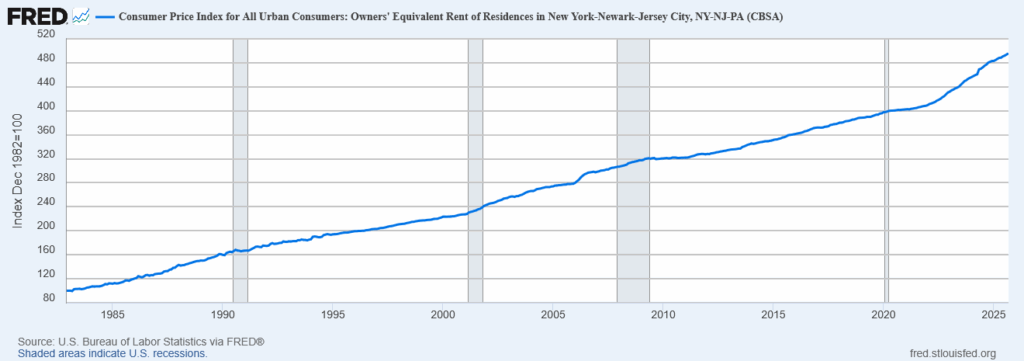
U.S. Bureau of Labor Statistics, Consumer Price Index for All Urban Consumers: Owners’ Equivalent Rent of Residences in New York-Newark-Jersey City, NY-NJ-PA (CBSA) [CUURA101SEHC], retrieved from FRED, Federal Reserve Bank of St. Louis; https://fred.stlouisfed.org/series/CUURA101SEHC, November 10, 2025.
Similarly, a $30 minimum wage in New York City sounds nice, until you realize that instead of a low wage, those companies just reduce hiring and raise prices to levels no one can afford. Instead of a low-wage job, you price yourself out of any job at all. For small businesses and service industries, the ability to absorb labor-cost shocks is paper-thin. Once forced to pay far more than they can afford to pay for basic entry-level jobs like cashiers, attendants, and shelf stockers, companies will fold or go elsewhere. Companies would become increasingly incentivized to invest in automation and strip benefits. Again, every problem Mamdani claims to solve would become massively worse.
Running grocery stores through the city means direct competition with private firms, leading to problems with managerial efficiency, supply chains, and cost control. City-run enterprises have notoriously mixed results. And free transport means the MTA would have to offset already-massive lost fare revenues through taxes or service cuts.
So just collect the revenue from billionaires, of which NYC has plenty, right? Boosting corporate taxes and surcharging the top 1% is a great way to encourage the rich to simply go (or invest) elsewhere, while working-class folks become even more stuck where they are: a city with a shrinking tax base and plummeting growth. The end result is that you’re eliminating the very revenue needed to fund the promised programs.
“Free stuff” platforms like Mamdani’s are childish and exploitative, appealing to a populace that is increasingly desperate and lacks the financial understanding to see how they would take bad problems and make them even worse. Mamdani says he speaks for the working-class New Yorker, the renter, the small-business employee, but they’re the ones who would end up getting screwed. Rent freezes may help existing tenants temporarily, but they worsen housing quality and availability, pushing lower-income people further into competition for fewer units.
The law of unintended economic consequences is always ready to teach its lessons, but unfortunately, New Yorkers would be learning the hard way. The cost is borne by people who rely on a vibrant economy and affordable housing and jobs, not by elites.
Mamdani’s promises appeal to frustrations about the cost of living, the affordability of housing, and stagnating wages as prices skyrocket. But these issues go far beyond New York City, far beyond Mamdani’s jurisdiction. Until we fix the problems caused by more government control and centralization, New York will continue to suffer. Mamdani’s trick, like that of all Socialists, is that more government will solve the problems that were created by central planning to begin with.
As Mamdani said himself:
“There is no problem too large for government to solve, and no concern too small for it to care about.”
In other words, prepare to be micromanaged into economic oblivion.

 Live Chat
 Email:
  Phone: 1-888-465-3160