Toilet Paper, Chicken, and Bullion
Costco will sell you just about anything: a 48-pack of toilet paper, a five-pound bag of shredded cheese, a $1.50 hot dog.
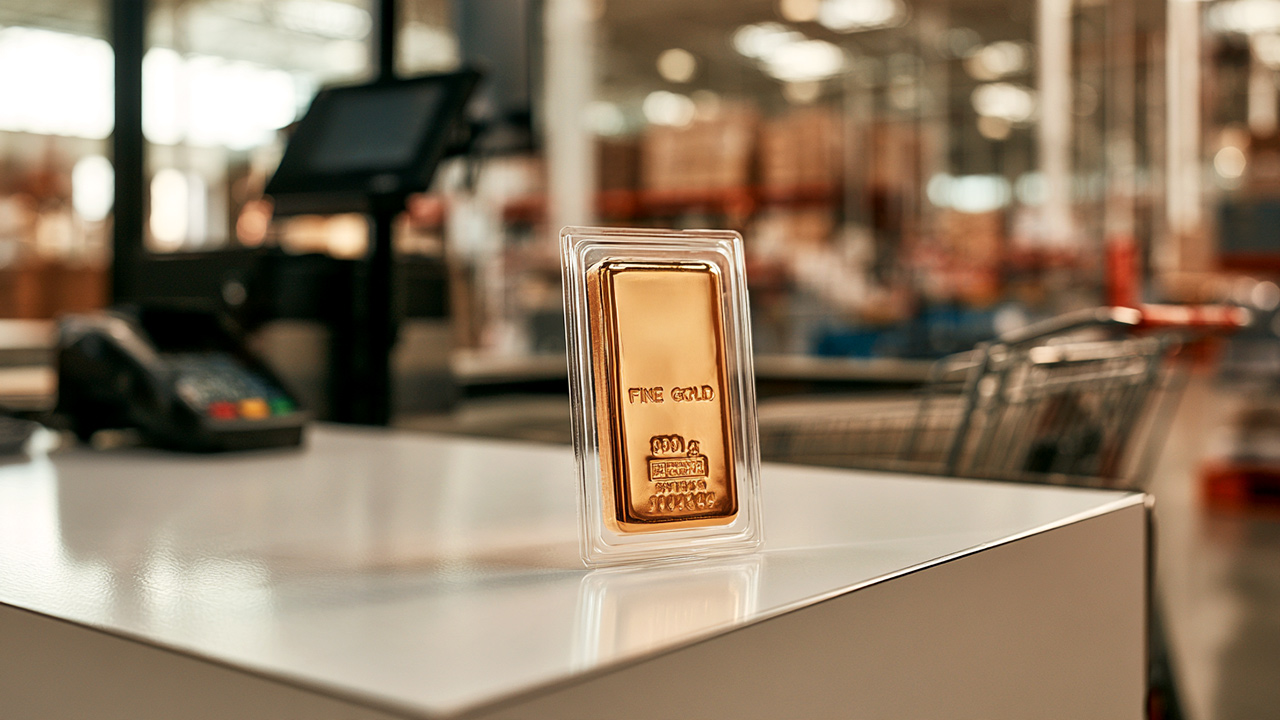
And, apparently, a bar of gold.
The same warehouse club that built its reputation on selling everyday necessities in bulk has become a serious player in the precious metals business. In 2024, Wells Fargo estimated that Costco was selling as much as $200 million in gold and silver every month, according to CBS News.
That’s a lot of gold bars to move alongside the rotisserie chickens.
But Costco’s success raises a more interesting question than how many bars it can sell. Why are Americans increasingly comfortable buying investment-grade bullion from a warehouse club?
Ease and accessibility.
For years, buying physical gold meant finding a coin dealer, researching precious metals, or speaking with a specialist. You needed to understand spot prices, premiums, authenticity, and storage.
Now you can buy a one-ounce gold bar from the same retailer that sells your laundry detergent.
That’s a significant change.
Costco already has something most gold dealers spend years trying to build: consumer trust. Its members expect competitive prices and relatively straightforward transactions. Putting gold on Costco’s shelves makes an unfamiliar investment feel like an ordinary purchase.
In its first-quarter 2026 report, the World Gold Council identified recurring bullion orders from mass-market retailers like Costco as a structural expansion of American retail gold demand.
In other words, Costco isn’t simply participating in the gold market; it’s helping introduce that market to a broader audience.
Peter Schiff even addressed Costco’s gold bars in a 2023 investor Q&A, shortly after the retailer began offering them.
Who knew a Costco card would be the catalyst to take gold sales mainstream.
Is Costco Actually a Good Place to Buy Gold?
Here’s where Costco’s business model gets interesting.
Most retailers sell products to earn a margin on the merchandise. Costco does that too, but membership fees are central to its profitability. Competitive prices encourage customers to renew their memberships and keep shopping.
Gold fits surprisingly well into that model.
It’s valuable, compact, standardized, and relatively easy to compare against a market price. Costco doesn’t need to convince someone that its particular gold bar is fashionable. An ounce of investment-grade gold is worth its weight in gold, literally.
The retailer has also offered pricing that can be attractive after eligible membership and credit-card rewards. The World Gold Council reported that Costco’s gold business was thriving in 2025, supported by consumer trust and competitive pricing.
But there’s a catch. Gold has a spot price, the benchmark value of the metal itself. The price you actually pay for a bar generally includes a premium covering fabrication, distribution, and dealer costs.
As SchiffGold explains in its discussion of premiums, those additional costs vary across products and sellers.
A $4,000 gold bar purchased for $4,100 doesn’t automatically become worth $4,100 the moment you receive it. If you sold it immediately, the dealer’s bid could be lower.
And Costco’s advertised price isn’t necessarily the best available price.
Rewards eligibility, purchase limits, taxes, and competing dealer offers can all change the calculation. A good deal on paper towels doesn’t guarantee the best deal on precious metals.
America’s Gold Rush Isn’t Quite What It Looks Like
Costco’s popularity might suggest Americans are buying physical gold faster than ever.
The broader numbers tell a more complicated story.
According to the World Gold Council’s full-year 2025 report, U.S. gold demand surged 140% to 679 metric tons in 2025. But most of that growth came from gold-backed exchange-traded funds.
Physical bar-and-coin demand actually declined.
That’s an important distinction.
Investors can buy gold through bullion, coins, ETFs, and other financial products. Each provides a different combination of convenience, liquidity, cost, and ownership.
An ETF can offer convenient exposure to gold’s price without requiring the investor to store a metal bar. But, as SchiffGold notes in its explanation of gold ETFs, owning fund shares is different from personally possessing physical bullion.
Meanwhile, demand for physical gold can vary considerably with prices and market conditions. SchiffGold has previously examined how slower U.S. Mint sales can push coin premiums lower, illustrating that the retail bullion market has its own supply-and-demand dynamics.
Costco’s success doesn’t prove everyone is abandoning stocks or preparing for the collapse of the dollar. It demonstrates that buying physical gold has become more accessible.
A Gold Bar Is Still a Gold Bar
There’s something amusing about purchasing a gold bar where you buy your groceries. But once you’ve checked out, the economics are no different.
Gold prices can rise or fall. Physical bullion must be stored securely. Selling it requires finding a buyer and understanding the price you’ll receive.
Costco can simplify the transaction. It can’t eliminate those considerations.
Still, there’s a larger story here.
A retailer best known for selling everyday necessities has found an audience for an asset historically associated with central banks, wealthy investors, and financial uncertainty.
Maybe some customers are worried about the dollar. Maybe others want portfolio diversification. And maybe some simply see a competitive price on a product they’ve been considering for years.
Whatever their motivation, Costco has made buying gold accessible.

 Live Chat
 Email:
 Phone: 1-888-465-3160