Distributism is Built for Failure
Distributism is a recently resurgent form of social and political thought that attempts to create a free society ordered in a specific way through state intervention. This sounds like a paradox, because it is one. Distributists do not like to believe that they are proponents of larger forms of government, however their policies almost inevitably create big government. They want production to be distributed, and are willing to use aggressive antitrust to do so. They believe that because of the many benefits of more people producing, antitrust, and market control is justified. Although the end goal towards which they regulate is beautiful, they fail to consider the practical implications of such paternalistic action. Distributists want to maximize human freedom and flourishing yet their economic ideas fundamentally disrupt both of those things. Flourishing is disrupted by arbitrarily destroying the industries of massive scale that enable material well-being. They damage freedom by replacing freedom of self-organization with state-created and enforced rules that limit creativity to a certain subset of it.
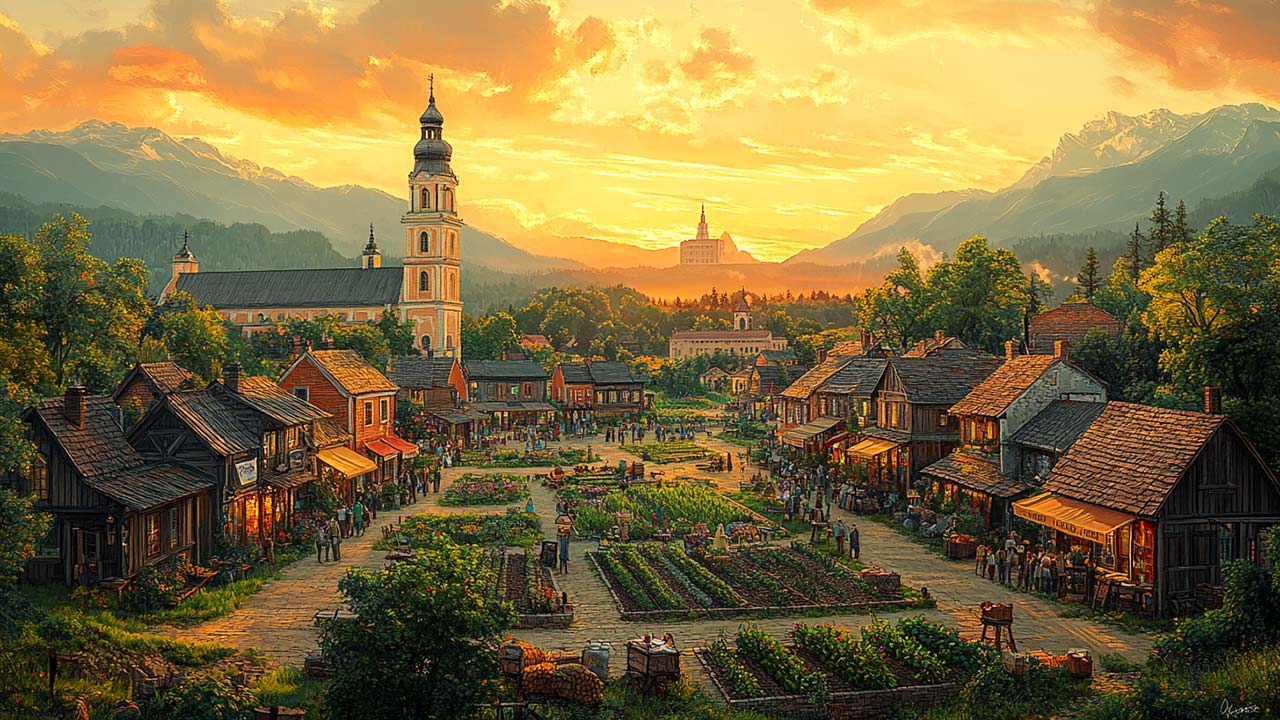
The distributists are interested in a clear problem: in most capitalistic and socialistic societies, most normal people do not own very much and thus become dependent on the state and vulnerable to abuse of industry. They argue that a large and centralized state creates people who are dependent. They also argue that an economy full of massive companies grows a similar form of dependence. This inability to be responsible for oneself and resilient to shocks of policy or the market creates people who are neither moral nor capable. Distributists have a clear and beautiful vision of the world, a world full of small farmers, collective workshops, and micro-entrepreneurs. They embrace the aesthetic of medieval Europe and hope to regain the communal life that once flourished there while also receiving more modern levels of resources. They want a world with all the good things of every time simultaneously. This is possible, but the creators of the movement being philosophers rather than economists becomes painfully clear when the practical ramifications of their strategies are considered. While increasing community and local resilience while also increasing business capacity is a good goal, they go about it in a methodologically corrupt way.
Distributists hold a fundamental skepticism towards the market and the price system. They believe that antitrust and heavy market regulations can reshape the world in the aesthetic and cultural form that they desire. Being deeply grounded in Catholic social teaching, they should have been able to recognize that market forces have only a limited power to change human nature. Even if regulations created a specific form of economy, they would have little power to create thoughtful and creative people. They believe that the selfishness and suboptimal outcomes seen in the market would disappear when more power was given to bureaucrats. While claiming to reject socialism, they granted the fundamental premise of it that the state can be better at managing resources than the people. While advocating for small government, their call for antitrust and heavy business regulation lays the framework for a bloated state and, paradoxically, larger businesses. Antitrust rewards the people with the loudest voice, and the groups with the loudest voices will be large associations and relatively larger businesses. The regulations they point toward as their desired end state would lead to bureaucratic tyranny, concentration of power, and an even stronger version of the government-regulator and big-business alliance we see today. In attempting to dismantle the alliance between big government and big business, distributists have written the blueprint for its entrenchment.
What distributists lack is not a vision, but a strong understanding of method. Their goals of strong community, distributed ownership, and freedom can naturally coexist, but strong market regulation is not the path towards this. Stable and simple regulations that make it difficult for businesses to rent-seek are the building blocks on which their vision should depend. A gutted central government with an accountable and incentive-aligned local government would be far more effective at creating the world they want to see. Rather than naturally emerging in environments of strong business regulation, small businesses are actually much less likely to arise. Only large businesses can survive the massive cost of dealing with excessive regulation. The community support they desire is far less likely to emerge in a welfare state than a state with minimal intervention. Although arguments can be made for a minimal safety net, the state currently provides so much financial support to its people that the community is often disincentivized through depersonalized, centrally planned aid.

 Live Chat
 Email:
  Phone: 1-888-465-3160