Peter's Blog
Get the latest headlines, market analysis, and original content from SchiffGold.
Posts Tagged: “free markets“

Binary and Marginal Games: The Socialist Flaw
On a recent podcast with Theo Von, New York mayor Zohran Mamdani defined socialism as “everyone having access to the things necessary for a dignified life.” Theo Von seemed to empathize with him, talking about how at a certain point economic issues are bigger than politics, and that incumbents can be challenged by longshot socialist […]

Exclusive Weekly Email Updates
Peter Schiffs's Gold News
 Original Analysis
 Videos
 Interviews
 Guest Commentaries
 Key Gold Headlines
 Gold Scams Exposed
 Exploring Finance
Welfare and Nationalists
Since Trump’s first term, a driving force among nationalist conservatives is a desire to limit immigration. The whole movement has an aura of survivalism about it. Conservatives feel that they are being replaced by people with a different culture than themselves. They are afraid that through democracy, their country will be taken away from them, […]
Peter Schiff: Trump’s Economic Boom is an Illusion
In his latest podcast, Peter pokes holes in President Trump’s latest economic narrative, contrasting it with the reality consumers are feeling on the ground. He also tackles the administration’s flip-flop on Russian energy imports, takes a jab at artificial intelligence branding, and closes out with sharp critiques of a politically compromised Fed investigation and the […]

The Problem With Socialist Monopolies
Democratic socialists routinely accuse capitalism of producing harmful monopolies, yet their preferred remedy, turning industries into public utilities, simply hands one single entity, the state, total and coercive control instead. Interventionists of all stripes don’t realize that monopoly is enabled and created by government policy, not inherent features of free markets. The following article was […]
The Cult of the Colossal and Industrial Strength
Wilhelm Röpke warned us 80 years ago about a threat that would only grow after his death. He saw that Nietzsche and other philosophers of the 19th century almost worshiped size. They believed that scale was a good in itself and they pedestalized it. Whether glorifying powerful states or leaning into the depersonalized aesthetic, the […]

Entrepreneurship as the Pursuit of Beauty
Entrepreneurship is at its core nothing more than the pursuit of beauty. Although an entrepreneur shares many activities with an employee, the nature of the activity is oriented towards beauty rather than anything else. This is not merely a philosophical preference, but rather the nature of entrepreneurship itself. Beauty is, while not necessarily definable, recognizable […]
Distributism is Built for Failure
Distributism is a recently resurgent form of social and political thought that attempts to create a free society ordered in a specific way through state intervention. This sounds like a paradox, because it is one. Distributists do not like to believe that they are proponents of larger forms of government, however their policies almost inevitably […]
Socialism Is Pure Inefficiency
Rather than being a radical antidote to the perceived errors of market capitalism, socialism is actually very similar to capitalism, but with some extra steps of inefficiency. Capitalism often consolidates the means of production through increasing returns to scale, and sorts people through the pice system into the roles where they would add the most […]
Deregulation Is the Only Hope For Big Government
Although deregulation is not often supported by those who support big government, it is actually the most realistic path forward for those who support an expensive state. Decades of deficits and poor management have led to a massive national debt and ever-growing interest payments. The interest payment is now similar to traditionally large expenses like […]

Why Eliminating Cash Would Harm the Market Economy
Monetary authorities increasingly argue for eliminating physical cash altogether, citing tax evasion, the shadow economy, and the instability caused when people run for cash during a crisis. But money is a commodity that emerged through voluntary market selection, not something a central bank can conjure by decree, and abolishing cash strikes at the medium of […]
Labor Day’s History of Violence
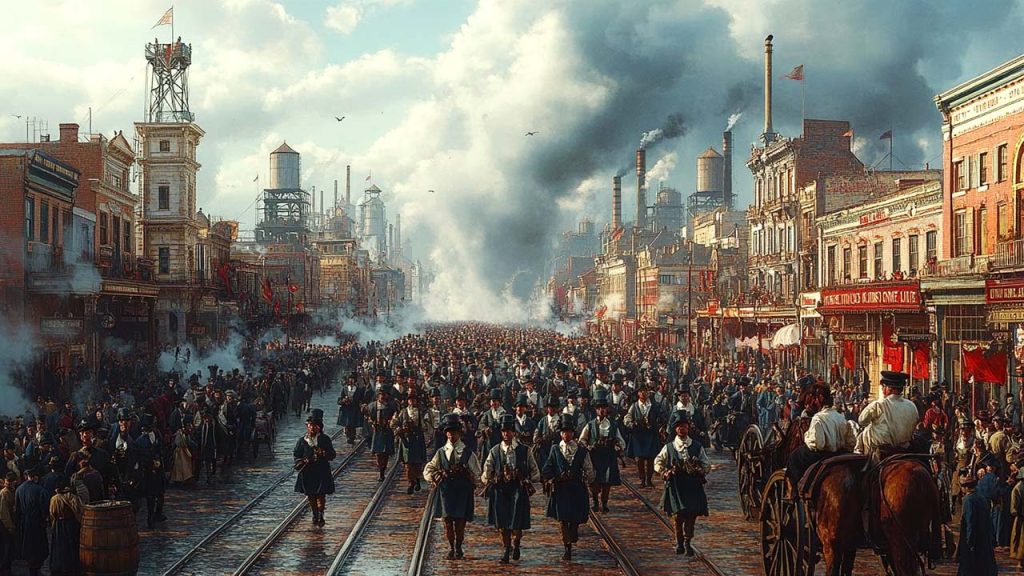
Every first Monday in September, Americans get a three-day weekend. Barbecues fire up, stores run sales, and politicians give speeches about “the dignity of work.” Labor Day is sold as a straightforward tribute to the American worker. But, as with most official retellings of historical turning points, the real history of Labor Day is a […]
 Live Chat
 Email:
  Phone: 1-888-465-3160