Gold Prices Go Up. Rolex Prices Follow. So Why Don’t They Come Back Down?
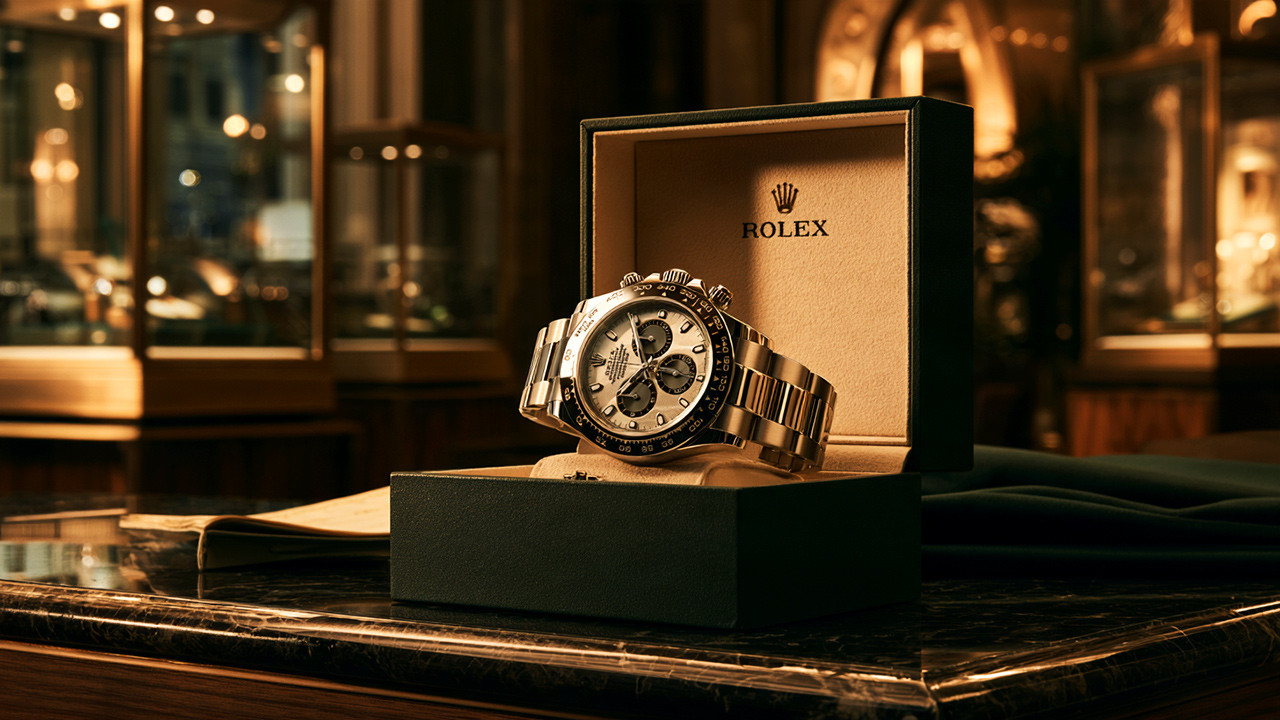
If you walked into a Rolex dealer in 2024 and tried on a white-gold Daytona, you’d have been looking at a watch that cost considerably less than it does today.
The same watch now retails for roughly $59,100, about 33% more than it did two years ago. In June alone, Rolex raised prices on its gold watches by another 5%, according to Reuters.
Gold has gotten considerably more expensive, and Rolex has been raising prices along with it.
But here’s a question worth asking: if gold falls 20% next year, will Rolex knock 20% off the price of your Daytona?
Probably not.
That’s because the price of gold and the price of a gold Rolex are determined in two very different markets.
How Much Gold Is Actually in a Rolex?
Rolex manufactures its gold watches using 18-karat gold, an alloy containing 75% pure gold mixed with other metals for durability. As Rolex explains in its own description of its gold alloys, the company even operates its own foundry to control the production of its precious metals.
A solid-gold Rolex contains substantially more precious metal than a stainless-steel model, particularly when the bracelet is also made of gold.
That metal has real value. And as gold prices increase, so does the cost of the raw material required to manufacture the watch.
But a $59,100 Daytona doesn’t contain $59,100 worth of gold.
You’re also paying for the movement, engineering, craftsmanship, distribution, and, perhaps most importantly, the Rolex name.
A gold bar is valued primarily for its metal content. A Rolex is valued for everything built around that metal.
This distinction becomes particularly important when gold prices fluctuate.
Why Rolex Prices Go Up but Rarely Come Down
Imagine Rolex raises the price of a gold watch from $40,000 to $45,000 after a significant increase in gold prices.
Six months later, gold falls 15%.
The raw material cost of producing the watch has declined. But Rolex isn’t obligated to pass those savings along to consumers.
Unlike gold, which trades continuously in global markets, Rolex controls its official retail prices. Those prices reflect production costs, currency movements, competitive positioning, and the company’s broader luxury strategy.
There’s also a psychological component.
Luxury brands depend partly on exclusivity and perceived value. Frequent price reductions can undermine both. A customer who paid $45,000 for a watch probably wouldn’t appreciate seeing the same model advertised for $39,000 a few months later.
And Rolex has little incentive to introduce that uncertainty into the buying process.
This doesn’t mean Rolex never lowers prices or that every increase is permanent. It means retail prices aren’t automatically adjusted every time the underlying commodity becomes cheaper.
Gold trades like a commodity. Rolex prices its watches like luxury goods.
The Secondhand Market Tells Another Story
While Rolex controls the prices of new watches sold through authorized dealers, it doesn’t control what collectors are willing to pay for used ones.
And the secondary market doesn’t always move in the same direction as gold.
According to WatchCharts, gold appreciated more than 60% during 2025, while its secondary-market index for the Rolex Day-Date increased just 5.7%.
WatchCharts estimated that the value of the gold inside a Day-Date 40 increased by roughly $7,000 that year. Yet none of the 15 most frequently traded Day-Date references appreciated by more than $5,000.
Think about that.
The gold inside the watch became substantially more valuable, but the watch itself didn’t appreciate nearly as much.
That’s because buyers aren’t valuing a Rolex exclusively by the weight of its gold. They’re also considering the model, condition, availability, collectibility, and what other buyers are willing to pay.
A Rolex can lose resale value even as the metal inside it appreciates. Conversely, a particularly desirable stainless-steel model can trade at a substantial premium despite containing almost no precious metal.
The broader luxury watch market demonstrated this during the correction that followed the pandemic-era collecting boom. WatchCharts’ mid-2025 market analysis documented how secondary-market prices continued declining even as manufacturers raised official retail prices.
The distinction between retail prices and resale values matters, particularly for buyers who think of luxury watches as investments.
Gold Is a Store of Value. A Rolex Is a Luxury Good.
There is a premium associated with buying physical gold, too.
Coins and bars typically sell above the spot price because of fabrication, distribution, and dealer costs. As SchiffGold explains, those premiums vary depending on the product and market conditions.
But with investment-grade bullion, the underlying gold content remains the primary driver of value.
With a Rolex, the premium is considerably more complicated.
The value of the metal matters, but so do brand perception, consumer preferences, scarcity, and the strength of the luxury goods market.
SchiffGold has explored a similar distinction in its discussion of gold jewelry as an investment, highlighting how jewelry priced transparently by metal weight differs from conventional luxury jewelry with substantial brand and retail markups.
If gold appreciates 25%, there’s no guarantee a gold Rolex will appreciate 25%. And if gold falls, there’s no guarantee the watch will become cheaper.
A Rolex might hold its value remarkably well, or it might depreciate. That depends on factors that have relatively little to do with the price of gold.
There’s nothing wrong with buying a luxury watch. Rolex makes a beautiful product, and some models have proven exceptionally desirable among collectors.
But buying a gold Rolex and investing in gold are two different propositions. SchiffGold’s coverage of physical gold investment demand illustrates how bullion and jewelry occupy different segments of the gold market, while its reporting on gold’s role as a financial safe haven underscores why investors purchase the metal independently of its use in luxury goods.
If you want a beautiful watch, buy the Rolex. If you want exposure to gold, buy gold.
Just don’t confuse the price of one with the value of the other.

 Live Chat
 Email:
 Phone: 1-888-465-3160