
Modern Silver Bull Markets: 1970s to Today
Silver has been long-maligned as the “poor man’s gold,” but history shows that when it runs, it often outperforms gold by multiples. In fact, silver has delivered some of the most dramatic bull markets in modern financial history.
As we watch silver gather momentum in the current cycle, it’s worth looking back at previous silver bull runs, what triggered them, and how today’s macro environment sets the stage for what could be silver’s most explosive move yet.
The 1970s Bull Market: Inflation, Oil, and the Hunt Brothers
In 1971, President Nixon officially took the U.S. off the gold standard, untethering the dollar from precious metals. What followed was a decade of stagflation not unlike our current scenario, where high inflation combines with low growth. Silver began the decade around $1.50/oz and climbed slowly with inflation, maintaining its value against a declining dollar. But later that decade, as inflation exploded and fiat money faced a crisis of confidence, oil shocks in an increasingly unstable Middle East caused silver to rip even higher.
Then, famously, a family of oil magnates named the Hunt Brothers attempted to corner the silver market. From the early 70s to around 1980, they accumulated over 100 million ounces of physical silver and futures contracts…nearly a third of the entire non-State held global supply. It ignited a fervor that took silver from $6 an ounce in the late 70s to nearly $50 an ounce in early 1980.
A stunning silver crash ensued that would become known as Silver Thursday. It was a lesson not only for regulators, but also for any market watchers who might be curious about how volatile silver can be under certain market conditions. Their scheme inspired new regulations surrounding margin requirements for commodity buyers, since the Hunts relied heavily on borrowed money for their purchases.
2001–2011 Bull Market: War Printing and the Chinese Supercycle
Silver’s next major bull run came in the 2000s. After bottoming in 2001 at just over $4.00/oz, silver began a decade-long rally that peaked in April 2011 at nearly $50 an ounce, nearly matching the Hunt brothers era.
After 9/11, an inflationary period began that was sparked by Bush’s permanent “War on Terror,” justifying massive spending to fight global wars and expand domestic bureaucracies. Meanwhile, China’s economy was rapidly expanding. Its meteoric ascent to challenge US dominance brought with it a commodity supercycle, where demand for raw materials caused a violent rise in commodity prices.
Later, of course, the subprime mortgage market collapsed, helping to trigger the 2007-2008 Financial Crisis. Unprecedented Quantitative Easing programs from the Fed printed trillions and taxpayer bailouts were passed by lawmakers, massively expanding the money supply and sending silver soaring further as the dollar was aggressively debased.
By 2011, silver began to tumble back down again, falling over 70%.
That would all change again in 2020.
Covid’s Monetary Floodgates
Between the Covid Crash in March 2020 and the following August, silver would boom amidst a flurry of pandemic panic and broad global uncertainty. The pandemic response consisted of years of ultra-loose monetary policy and trillions of dollars printed, part of which consisted of checks that were sent directly to American citizens. Retail investors flocked to metals and ETFs to protect themselves.
Briefly, traders organizing on Reddit even took a page from the Hunt Brothers’s book and coordinated to create a silver squeeze. The activist traders were hoping to expose silver price manipulation in the paper silver markets. It didn’t last, but all that Covid money printing has set the stage for what’s happening now.
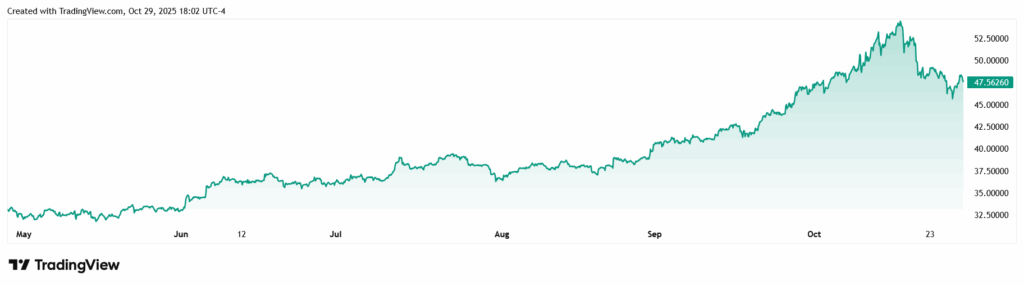
Silver vs. USD, 6-Month
2025-2026: The Unraveling?
Silver is finally on the move again after gold began to skyrocket in the beginning of this year. As the gold-silver ratio shot higher and higher, it was all but assured that a silver bull would eventually follow. Now, the catalysts are stacked for remnants of reckless, reactionary 2020 policies to rear their ugly heads as they combine forces with a new wave of inflationary pressures and global uncertainty.
Like the 1970s, inflation from Covid-era money printing remains a stick in the side of Federal Reserve decision-makers. Even with official CPI readings coming down, real rates remain deeply negative, especially when adjusted for true increases in the cost of living. In the 1970s, silver was the best-performing asset during inflationary periods. Today, many investors are rediscovering silver’s role as a monetary hedge against an inflationary monster that, on the ground, is astoundingly obvious even if central banks and governments prefer to deny it.
Unlike previous cycles, today’s backdrop also includes unprecedented sovereign debt levels. The U.S. debt-to-GDP ratio is above 130% and Japan, the EU, and China are also drowning in debt. Central banks are trapped between a rock and a hard place. Their choices are: default or debasement? This dynamic has always lurked in the background, but didn’t exist to the same extent in prior bull runs than it does today.
Meanwhile, de-dollarization efforts keep accelerating. We’re seeing record gold purchases by central banks, especially in the Global South. While silver isn’t bought at the same scale institutionally, the trend reflects a global shift away from dollar hegemony, and gold is far from the only benefactor.
The rise of EVs, silver photovoltaics, and other technological demand is a sprinkling of extra fuel for silver’s current fire. Once used in industry, silver is taken off the market forever. With industrial demand expected to boom dramatically in the next half-decade, creating a hybrid catalyst of industrial growth, plummeting institutional trust, and monetary panic amidst a growing and serious supply deficit that’s multiple-years running. This time, even more factors are conspiring to slingshot silver higher. With the current setup and more rate cuts likely on the way, an economic crash could quickly escalate into a proper currency crisis.
And in a serious crisis, even with corrections in precious metals along the way, the sky’s the limit for gold and silver both.

 Live Chat
 Email:
  Phone: 1-888-465-3160