
The Working Americans’ Tax Cut Act Robs Peter to Pay Paul
If you listen to politicians in Washington, the Working Americans’ Tax Cut Act proposed by Virginia Representative Don Beyer sounds like a gift to the middle class. But by decreasing taxes for some by increasing them for others, it only robs Peter to pay Paul.
A tax decrease that is financed by a simultaneous tax hike might temporarily make a core group of voters happy, but isn’t a serious way to relieve economic pressure. Under the proposal, millions of middle-income Americans would see their federal income taxes reduced or even eliminated. Some workers below a certain threshold, roughly what is considered a “living wage,” would pay no federal income tax at all.
One of the bill’s selling points is that it’s “budget neutral,” but not for the Americans whose taxes will go up. The lost revenue from this “tax cut” is replaced with a new surtax on individuals earning over $1 million per year. Lawmakers claim this surcharge could raise around $1.5 trillion over a decade. In other words, rather than cutting taxes, the government is just shifting the burden.
But this position isn’t about “favoring the rich” over the middle class. It’s about being intellectually honest about the fact that the government, at the end of the day, can’t give you anything that it hasn’t taken from somebody else.
Supporters argue that millionaires can afford to pay more, which is an argument that may win votes, but ignores how economies actually work. High-income earners are not piggy banks. They are often business owners, investors, and capital allocators. When you penalize them, you reduce their income while also reducing the things that make economies healthy like investment, hiring, and economic growth. We already have low growth and high inflation, and a tax redistribution scheme doesn’t solve either.
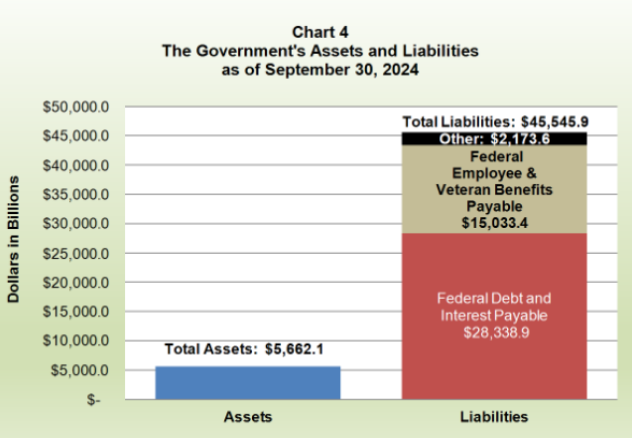
Source: Financial Report of the United States Government, Fiscal Year 2024, Department of the Treasury.
Beyond that, robbing Peter to pay Paul ignores the larger and more important point that the income tax probably shouldn’t exist at all. As the government and central banks grow our debt, debase our money, and engage in endless wars, the notion of an income tax paid to an out-of-control empire becomes morally questionable, aside from legal and constitutional arguments.
Taxes are part of an incentive structure that change behavior. If you impose a surtax on million-dollar earners, you create strong incentives to avoid, defer, or relocate income. Capital is mobile, which also means the projected revenue or $1.5 trillion is likely overstated. Even official analyses admit that there are complex tradeoffs, with some estimates showing the plan may still reduce overall federal revenue depending on assumptions.
Politicians gain support by promising benefits to one group, funded by another group that is smaller and politically convenient to target. But the long-term effect is to weaken the entire system by thinking you can efficiently redistribute prosperity. The government can’t create prosperity simply by printing money or reallocating income and shifting the tax burden around.
Money Supply (M1), 10-Year Chart
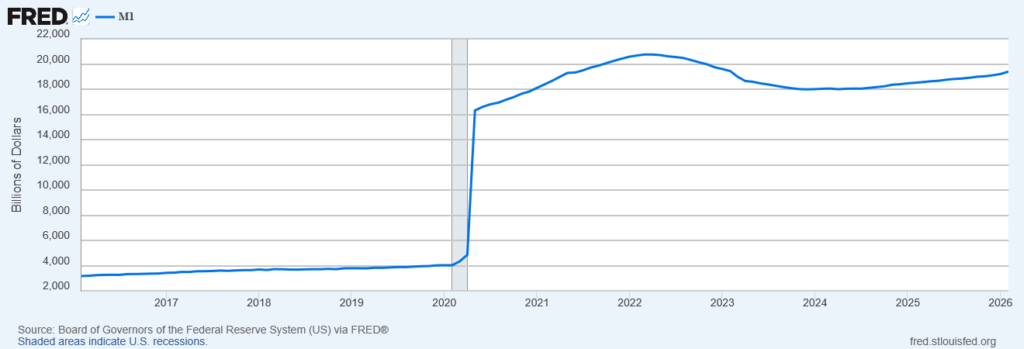
Source:Board of Governors of the Federal Reserve System (US), M1 [M1SL], retrieved from FRED, Federal Reserve Bank of St. Louis; https://fred.stlouisfed.org/series/M1SL, March 29, 2026.
Even if the surtax worked exactly as advertised, it wouldn’t fix any of our underlying problems, like runaway money printing and wanton fiscal irresponsibility. Instead of asking how to grow the economy and reduce government dependency, lawmakers are asking how to divide the pie differently or hand out more free money that will be redistributed from billionaires or printed out of thin air.
For another inconvenient truth, high-income taxpayers already shoulder a disproportionate share of federal income taxes. And in today’s economy, after decades of currency debasement, a “millionaire” means a lot less than it used to. Even if you use the official inflation numbers, which are much lower than the reality, you’d need over $2.5 million today to have the purchasing power of $1 million in 1990.
The more reliant the government becomes on a small group of taxpayers, the more fragile its revenue base becomes. When those taxpayers change behavior, or leave outright, the system breaks. At that point, the burden just shifts downward, as it always does. There’s no question this proposal would feel good in the short term for many Americans. Lower taxes for millions of Americans are politically popular for a reason, but short-term relief comes with long-term costs. It could also increase spending and money velocity, fueling inflationary price increases.
The Working Americans’ Tax Cut Act risks undermining the economic engine that makes prosperity possible in the first place. You can call it fairness, or relief from higher cost of living. But at its core, it’s the same old story: Rob Peter to pay Paul, hope Peter doesn’t notice, and ignore the law of unintended consequences all along the way.

 Live Chat
 Email:
  Phone: 1-888-465-3160