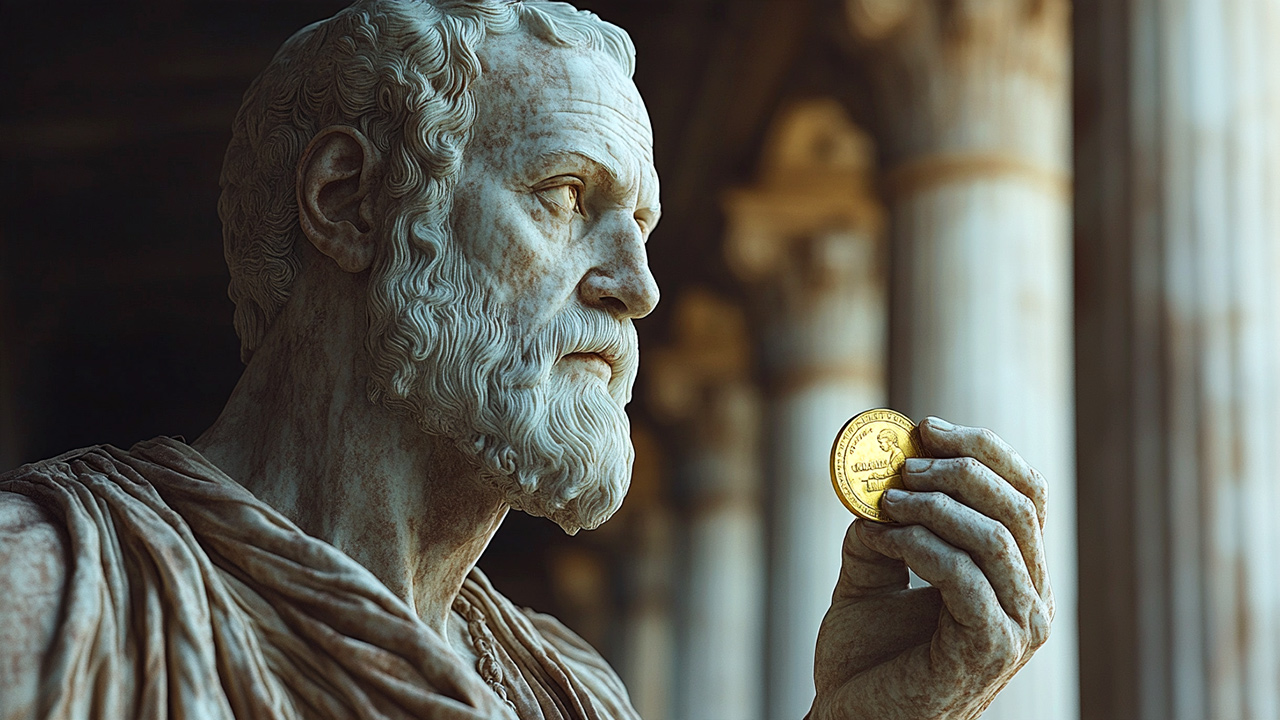
Aristotle would have supported the gold standard
Although Aristotle lived over 2000 years ago, he had ideas about money that are extremely relevant to today. He believed that rather than having some intrinsic worth, money was a human convention that enabled coordination between people. He also believed that money was best used to satisfy needs rather than wants, which he made it difficult to distinguish between. Additionally, he thought that it was wrong for money to make money. Although this would contradict most of the practices of the modern financial system, it would also reflect on the US government’s issuance of currency. Rather than there being some fundamental right of government issuance, Aristotle saw money as serving a very specific purpose. Constant and unpredictable inflation in the dollar would have made Aristotle wonder why we hadn’t simply switched to something that fulfilled the purpose of money better. The dollar has been repeatedly used to enable the purchase of wants while neglecting needs, reversing Aristotle’s prescription. The issuance of currency also provides the US government with money to spend and goes beyond profiting from deposits to profiting from devaluing deposits.
Aristotle’s focus on money as a medium of exchange would have made him a strong advocate of monetary stability. Money only functions as a medium of exchange because of its stability. Bitcoin would be seen as a poor currency by Aristotle because of how unstable it is, and most modern currencies would also be seen as inefficient because they made it difficult for people to coordinate effectively through constantly adjusting price. Although gold is not perfectly stable, it is not arbitrarily unstable, and if used widely enough, would be far more stable than our current fiat currency options. The ability of gold to be used across cultures and regulatory boundaries makes it even more obvious that Aristotle would support the use of it. Rather than just promoting coordination between people in one town, gold can allow it across the whole world. Gold is the ultimate medium of exchange and that hasn’t changed since the time of Aristotle. Gold removes the barriers constructed between different states and countries. It is truly a universal medium of exchange. Money controlled by the state has an inherent incentive to inflate which obviously makes coordination difficult and lets only the wealthy be resilient to price shocks.
Although Aristotle was primarily talking about individual consumption, he believed that there was a difference between using money to pay for needs and using money to pay for desires. He believed that this distinction was important because it helped clarify whether a person was using money morally or not. He would have been wary of how the dollar has been used to pay for an increase in historically unheard of levels of handouts, education spending, and vast bloat in government programs. None of these are necessities. They would all be considered luxuries by Aristotle. The enforcement of law and protection of private property both take a backseat to constant spending in luxurious areas. Aristotle promoted the right of individuals to own property as he saw it as a moral training ground. He would have opposed our current system, which erodes that which is necessary to pay for that which is not. A return to a gold standard would put at least one boundary on the constant expansion of government spending on luxury. Currency could no longer be manipulated to pay for irresponsible projects. It is difficult to see a world in which Aristotle would be a strong supporter of the US dollar, which continually enables higher spending on luxury goods rather than necessities.
Aristotle was a strong opponent of charging interest. He believed that loaning someone money and requesting an interest payment was attempting to make money create money when he thought that in reality it was barren. He believed that money should not serve a purpose beyond its exchange value and role as a store of value. He would have found the Fed’s constant devaluation of the money of citizens to be a form of usury. The central bank takes over 2% of the value out of the money of all who use the US dollar every year. Without even providing the service or bearing the risk of lending money, the central bank feels entitled to take away some of our purchasing power every year. Aristotle would have seen this as a great injustice and advocated for a system that didn’t allow such lucrative human control of money.

Receive SchiffGold’s key news stories in your inbox every week – click here – for a free subscription to his exclusive weekly email updates. Interested in learning how to buy gold and buy silver? Call 1-888-GOLD-160 and speak with a Precious Metals Specialist today!
 Live Chat
 Email:
  Phone: 1-888-465-3160