Metals Tell the Truth About the Economy
Gold and silver are sniffing out the inflationary regime. Rising together, even after pullbacks, the historic run in precious metals is part of a desperate SOS signal for the economy.
The Fed isn’t the only one printing money. Trump is floating plans for 50-year mortgages and payments for veterans, seeking any justification for “stimulus” that he possibly can. These measures expand the money supply as well, either directly or by increasing the amount of debt in the system.
Investors turn to gold when confidence in fiat currency weakens, when real returns look fragile, and when policymakers appear boxed in. Today’s environment checks all three boxes. Large and sustained deficits, higher debt servicing costs, and political incentives all favor spending over restraint, even if it means crushing the value of the dollar. Lawmakers and bankers have a powerful bias toward monetary accommodation, and gold’s sustained ascent reflects the growing spectre of a crushing economic collapse caused by interventionist policies.
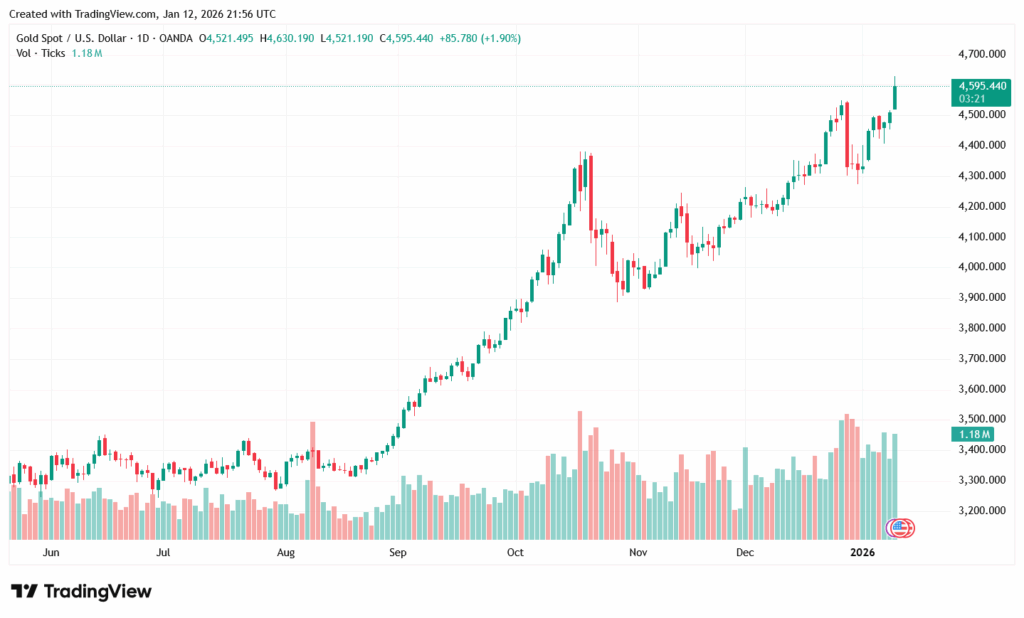
Gold is up over $80, a record high above $4,590. Silver is up over $4, a record high above $84. Prices are melting up for a reason, and it’s not good. While it’s exciting for those of us who own gold and silver, keep in mind that it foretells economic hardship for most Americans.
— Peter Schiff (@PeterSchiff) January 12, 2026
Inflation does not need to explode overnight for metals to surge; it only needs to outrun the yield that investors receive after inflation. Even modestly positive nominal rates fail to compensate when price pressures are persistent and unpredictable. Gold thrives when savers recognize that cash and bonds quietly lose value over time. The steady climb in metals means that markets expect inflation to erode real returns, regardless of short-term adjustments by the Fed.
Gold 1-Day
Meanwhile, the silver rally reflects both inflation hedging and rising replacement costs across the real economy. Energy transition projects, electronics, medical equipment, and manufacturing all rely on silver, so when its price breaks higher alongside gold, it implies that inflation pressures are spreading through supply chains, not just financial assets.
And for both metals, it isn’t retail buying that’s driving this surge. That means it’s based on macro factors and fundamentals, not some kind of “precious metals fever” among smaller investors. Metals aren’t in a bubble, but they might be the pin that pops it.
What’s most unique about this precious metals bull market is that I doubt there has ever been one this big with investor enthusiasm this low. Individual demand for physical precious metals remains muted, and stock investors are too worried about a price decline to buy miners.
— Peter Schiff (@PeterSchiff) January 6, 2026
Gold is the only neutral asset in a world where monetary trust is becoming more regional and conditional. Persistent central bank demand tightens supply and confirms a shared concern about long-term currency stability, all while countries distance themselves from the dollar.
While velocity slowed during periods of uncertainty, it tends to recover as confidence returns and fiscal spending continues. When large pools of liquidity begin circulating more actively, prices respond. Gold and silver often move early, anticipating that delayed effect. But with higher velocity of money, the effects of money printing are felt in force as prices rip upward.
Inflation expectations also feed on credibility. When households and businesses begin to assume higher future prices, behavior changes. Workers push for higher wages, firms raise prices preemptively, and contracts embed larger escalators. Precious metals rising to new highs send a psychological signal that inflation protection is no longer optional. That feedback loop can amplify the very forces metals are reacting to.
President Trump and Jerome Powell have one of the most contentious relationships in the history of the Federal Reserve. And while Powell’s Fed has been lowering rates “carefully,” and Trump wants the money printer to roar, both want the same thing:
Further expansion of the money supply when a currency crisis is already looming, hoping they can delay it long enough to convince America that they made the right call.

 Live Chat
 Email:
  Phone: 1-888-465-3160