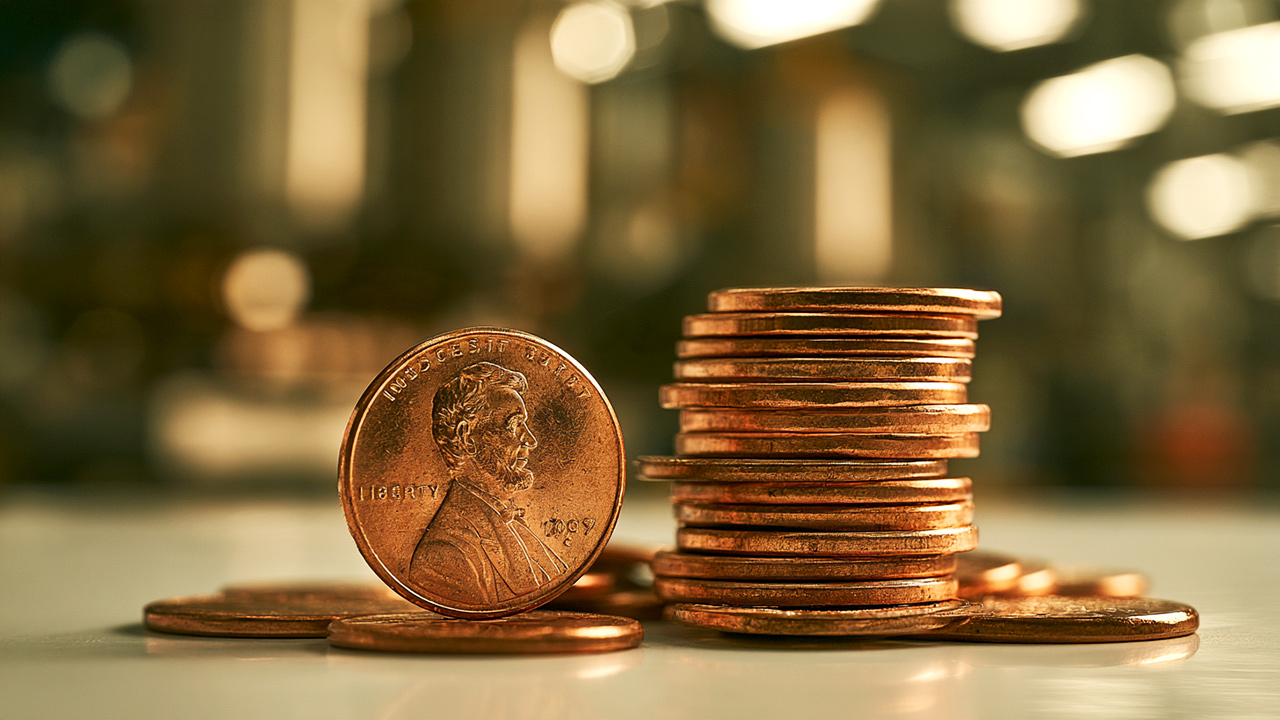
The Penny Costs 3.69 Cents to Make.
Imagine running a business where every time you sell a product for one cent, you spend four cents manufacturing. You’d probably reconsider your operating model quickly.
The United States government took many years to reconsider a similar situation.
For years, the U.S. Mint produced pennies that cost more to manufacture and distribute than their face value. By 2025, that cost had reached 3.69 cents per penny.
In a remarkable admission of poor expense management, the U.S. Mint announced on November 12, 2025 its final circulation of the penny, ending a 232-year production run.
A Penny for Your Thoughts. Three More to Manufacture It.
Pennies aren’t made primarily of copper anymore.
Since 1982, the familiar Lincoln cent has been composed mostly of zinc, with a thin copper coating. Zinc isn’t a precious metal, but it still costs money to purchase, transport, stamp, and distribute.
The machines, buildings, and employees needed to manufacture coins are also costly.
According to the Mint’s official penny FAQs, producing and distributing each penny eventually cost 3.69 cents.
That’s not the melt value of the metal inside. It’s the total production and distribution cost.
The difference matters.
Even if you melted down a modern penny, you wouldn’t necessarily recover 3.69 cents in raw materials. The government was spending that amount to deliver a finished one-cent coin into circulation.
As SchiffGold observed more than a decade ago, the penny had already become more expensive to produce than its face value.
At the time, the figure was approximately 1.6 cents.
What looked absurd in 2014 became considerably more absurd by 2025.
So Why Did We Keep Making Them?
Part of the answer is inertia.
Americans are accustomed to prices ending in 99 cents. Cash registers, vending systems, accounting practices, and consumer habits were built around denominations that included the penny.
There’s also a longstanding concern that eliminating the coin would force retailers to round prices upward.
But here’s the thing: eliminating penny production doesn’t eliminate the cent.
A $9.99 purchase can still cost $9.99. Credit cards, debit cards, and electronic transfers can continue settling transactions to the penny.
It’s cash transactions that may require rounding when pennies aren’t available.
The Treasury’s guidance on ending penny production addresses those practical complications. Rounding policies can vary, but generally apply to the final cash amount rather than changing every item’s advertised price.
That distinction matters to the person buying a $1.50 coffee just as much as to the retailer processing thousands of transactions daily.
The Last Penny Doesn’t Mean the Penny Is Gone
There’s another twist.
The government stopped manufacturing new circulating pennies, but existing pennies remain legal tender.
You can still spend them. Stores can still accept them. And banks can still process them.
Hundreds of billions of pennies were already out there when production ended.
In other words, the penny hasn’t disappeared. The government has simply stopped adding to the pile.
Reuters examined how the penny priced itself out of production, documenting the growing mismatch between its denomination and manufacturing cost.
It’s an unusual outcome for a monetary system.
The penny still represents one cent of purchasing power, even though creating a new physical penny cost considerably more.
When Money Stops Being Worth Its Ingredients
For most of American history, coins and precious metals had a much closer relationship.
Silver and gold once circulated as money, with denominations connected to specified quantities of metal.
That system changed over time.
The government removed silver from circulating dimes and quarters in 1965. Modern pennies are mostly zinc. And now even the cheapest circulating denomination has become too expensive to manufacture.
Peter Schiff has argued for a return to a stronger relationship between money and precious metals in Make Our Money Great Again.
That argument is different from the narrower economics of penny production. A penny can become uneconomical to manufacture because of labor, equipment, and metal costs without proving anything by itself about the future of the dollar.
But the contrast is revealing.
Older American silver coins can be worth many times their face value because of the metal they contain. SchiffGold’s guide to junk silver explains how that value is calculated, while its discussion of silver’s market value illustrates how precious-metal prices fluctuate independently of coin denominations.
A modern penny works in reverse. The government was spending several cents to manufacture a coin that the public would accept as just one cent.
Neither example means coins are inherently good or bad money. It means the economics of manufacturing money and the economics of using money aren’t the same.
The penny’s retirement won’t revolutionize American finance, but it’s departure is a sign of the times. After 232 years, the government finally decided that spending nearly four cents to make one cent wasn’t such a great deal. Even Washington has its limits.

 Live Chat
 Email:
 Phone: 1-888-465-3160