AI Will Destroy Jobs? Good
The AI bubble has become a frequent fixture in the financial news cycle as pundits and institutions express their fear that, when it pops, it could drag the global economy into crisis. Central bankers and institutions like the Bank for International Settlements (BIS) are sounding alarms about debt-fueled AI investments, overexuberance, fragile funding structures, and the potential for a sharp unwind that cascades into the rest of the economy.
These reports highlight legitimate concerns like massive capital spending by tech giants creating AI platforms that hemorrhage money, overreliance on private credit, and questions about whether productivity gains will really justify the hype. History shows tech booms tend to have frothy periods, especially with such rapid adoption of a new technology. But framing this as the primary path to a 2008-style meltdown is misguided. A deeper, more persistent danger lies in how policymakers respond to these shifts with government and central bank interventions, and the popular rallying cry to “save” the jobs that AI might take away.
Central banks and governments failed to predict the 2008 crisis along with many others. They ultimately profited, using the aftermath as a justification to intervene in markets and print money. But like all state tinkering in the economy, when it comes to reining in a technology, interventions distort markets and slow genuine progress. The real threat isn’t AI companies investing aggressively in a new technology. It’s the impulse to “manage” the transition, protect legacy jobs and industries, and regulate innovation into something safer but far less powerful.
Many of the same voices now cautioning about AI risks didn’t foresee the 2008 financial crisis clearly in advance. Warnings from analysts like Peter Schiff about housing bubbles, loose monetary policy, and unsustainable debt were often dismissed as pessimistic or even whacky. Institutions focused on models that assumed stability until it wasn’t. Today, similar language frames AI optimism as the new risk.
NVDA Stock Price, 5-Year Chart
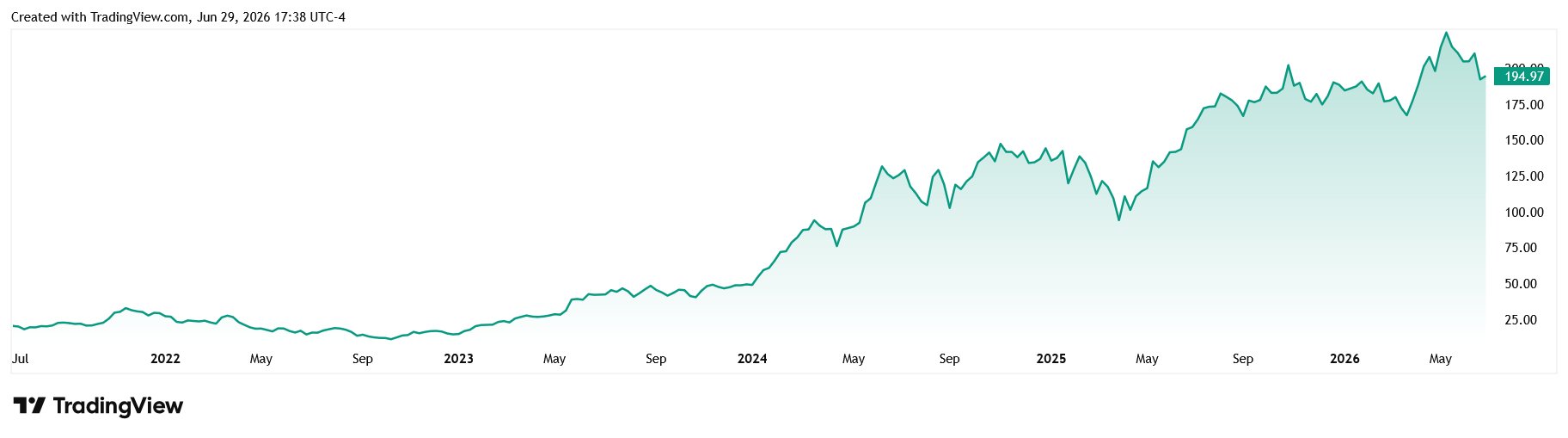
ChatGPT was released in 2022, foreshadowing NVIDIA’s meteoric rise
Excel at reactive tightening or stimulus, not at foreseeing how technology and human incentives reshape economies. Instead of letting markets allocate capital and labor through creative destruction, the temptation is always to intervene: bailouts for affected sectors, subsidies to “save” jobs, mandates for retraining, or new regulatory hurdles to slow deployment. These efforts rarely achieve their stated goals. They create dependencies, misdirect resources, and delay the very adjustments that lead to higher living standards.
Consider the transition from horse-drawn transport to automobiles in the early 20th century. At the peak, the US had millions of horses working in cities and farms. Farriers, stable hands, carriage makers, and feed suppliers formed a significant economic ecosystem. The rise of cars, trucks, and tractors displaced these roles rapidly. Cities had to deal with less manure on streets, but entire occupations vanished. Imagine policymakers at the time trying to “balance” this.
Subsidies for horse breeders, regulations requiring new cars to include features preserving buggy compatibility, or massive government retraining programs for coachmen to become… what, exactly? The economy didn’t collapse. Growth skyrocketed in a hockey stick pattern as new jobs emerged in manufacturing, petroleum, road construction, auto repair, logistics, and entirely unforeseen areas like suburban development and the entertainment industry that cars enabled.
Productivity soared, freeing labor for higher-value work. Real wages rose over time as goods and mobility became cheaper and more accessible. Whether or not AI is overhyped, trying to stifle and regulate it out of its ability to actually be powerful enough to replace jobs (and the economy) is a huge and predictable policy mistake.
The same pattern repeats across innovations. The Luddites in early 19th-century England smashed textile machinery fearing unemployment among weavers. Their concerns were understandable on an emotional level, but resisting mechanization didn’t preserve prosperity. It never does. It would have kept Britain poorer, with higher prices for cloth and slower industrial growth. Britain embraced the machines, and the broader economy expanded dramatically, creating far more jobs in new sectors.
Agriculture offers another clear example. In 1900, roughly 40% of the US workforce was on farms. Mechanization, fertilizers, and better techniques reduced that to just a few percent today. Did this cause mass unemployment and crisis? No. It liberated people to build cars, computers, healthcare systems, and services that define modern life.
The “saved” farm jobs would have been a tragic waste of human potential. If AI represents a similar leap, it will be primarily in cognitive and analytical work rather than muscle or routine physical labor, but also spilling into the latter with advances in robotics and next-generation manufacturing. AI can handle data analysis, coding assistance, customer service patterns, medical imaging review, logistics optimization, and creative iteration at scales and speeds unimaginable before.
Whatever jobs it displaces should be destroyed. Clinging to them through policy is like insisting we keep hand-weaving or horse stables subsidized indefinitely.
US Labor Force Participation Rate
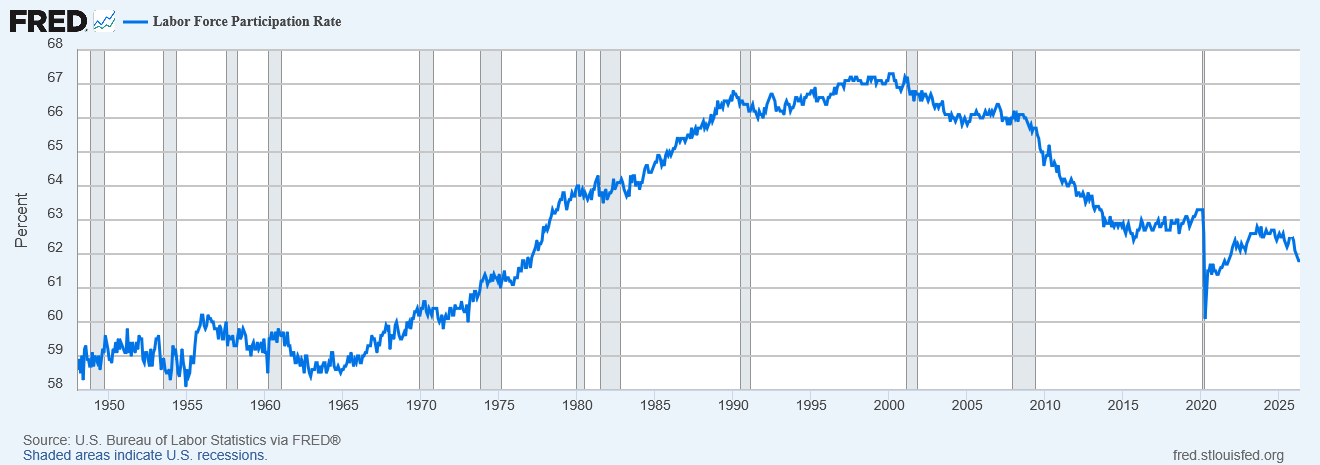
U.S. Bureau of Labor Statistics, Labor Force Participation Rate [CIVPART], retrieved from FRED, Federal Reserve Bank of St. Louis; https://fred.stlouisfed.org/series/CIVPART, June 29, 2026.
Today’s endless interventionist instincts risk repeating past mistakes on a larger scale. Proposals for AI “pause” letters, heavy licensing for models, union-style protections for coders or analysts, or taxes on automation to fund universal basic income sound compassionate. In practice, they create barriers to entry that favor incumbents, slow deployment, and reduce the competitive pressure that drives improvement.
In Europe, where tech regulation is more heavy-handed than in the US, strict data rules and AI Act-style frameworks are slowing adoption and potential growth. While the US and China race ahead in certain applications, bureaucratic hurdles can turn promising tools into compliance nightmares.
Over-regulation delays benefits, it raises costs, discourages startups, and pushes innovation offshore. Trying to contain an exuberant market rather than letting it run its course, to decide winners and losers, is the only way forward that doesn’t make existing problems worse.
Central bank policies compound this. Loose money helped fuel the AI investment surge, as noted in recent BIS commentary. But the response to any slowdown like further rate manipulation, targeted lending facilities for “strategic” sectors, or fiscal stimulus to prop up employment, distorts signals even more. Capital gets stuck in zombie firms or legacy industries instead of flowing to productive new uses.
It preserves inefficiency to shield specific jobs in spite of a technological advance that could replace them. It also raises prices for consumers, reduces competitiveness for businesses, and ultimately leaves everyone poorer. AI’s hype lies in the promise of augmenting human capabilities: doctors diagnosing faster and more accurately, engineers designing better products quicker, researchers accelerating scientific discovery. If it can really do those things, then bottling all that up to protect status quo employment statistics is a terrible idea.
The better path is restraint mixed with enabling conditions. Sound money that doesn’t inflate asset bubbles. Education systems that emphasize adaptability, critical thinking, and complementary skills AI doesn’t replicate well like creativity in context, physical trades, and complex interpersonal roles.
Markets have absorbed technological shifts for centuries because prices, profits, and losses guide resources better than central planners. AI won’t be different if allowed to evolve through competition. Overhyped investments will face corrections naturally; that’s healthy. The cascading crisis to fear is one manufactured by panic-driven policy: capital controls, innovation-killing rules, or monetary experiments that erode confidence and distort incentives.
Innovation has always destroyed old ways of working while creating richer possibilities. If AI can really take that many jobs, then let it cook: trying to restrict it to preserve a less efficient status quo is nothing short of insane. The US will be left behind.
Policymakers should step back and allow the destruction where it’s due.

 Live Chat
 Email:
  Phone: 1-888-465-3160