Consumer Sentiment Has Never Been This Bad
Consumer sentiment has hit an all-time low in America as the promises of Trumpenomics like a flood of tariff wealth, slashed income taxes, and lower prices are washed away by the tides of war, low growth, bad math, and money printing.
Politicians want to be good at math when it serves them, and terrible at it when it doesn’t. Trump’s tariffs never had a hope of adding up to anywhere near the levels needed to balance the budget or eliminate income tax, as promised. Consumers are broke, tired, indebted, and politically exhausted. That’s why consumer sentiment is lower than it has ever been since the University of Michigan began publishing its Michigan Survey of Consumers in the 1970s.
Inflation has proven sticky, with the money supply expanding and the war machine ramping up in the Middle East, even as our other wars fall into the background of the news cycle.
Rather than return America to prosperity, tariffs have created uncertainty, friction, and higher prices for Americans while incentivizing foreign countries to accelerate their efforts to ditch the dollar.
Politicians hope they can lift the mood with wealth redistribution schemes that ignore the real problems. The Working Americans Tax Cut Act claims to “reduce taxes,” when all it really does is changes who gets charged, and how much. All gifts from the government are taken from someone else, and with Americans constantly being robbed by the money printer through inflation, they may be starting to catch on that there are no free lunches, and lower taxes can’t fix the problem of a dollar that’s becoming increasingly worthless.
The University of Michigan’s Index of Consumer Sentiment crashed to 47.6 in preliminary April 2026 readings, shattering the previous record low set in mid-2022. The current conditions sub-index plunged to 50.1, also a record low, while expectations for the year ahead cratered even harder. Consumers aren’t just pessimistic about the present; they see no relief coming, “tax cuts” be damned.
University of Michigan: Consumer Sentiment (5-Year)
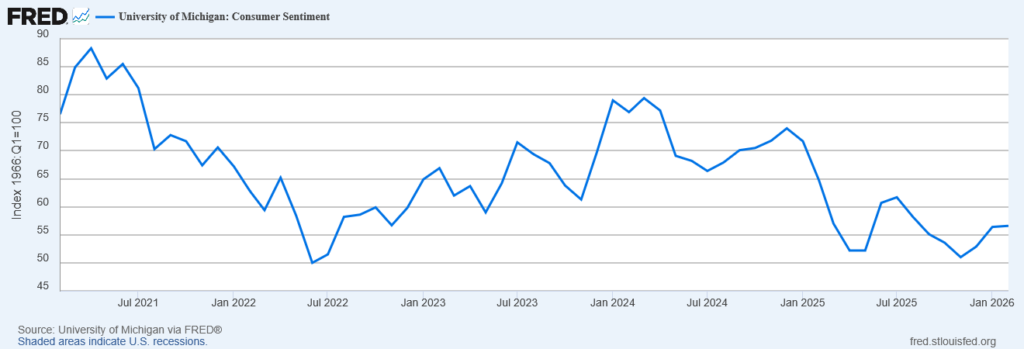
Surveys of Consumers, University of Michigan, University of Michigan: Consumer Sentiment © [UMCSENT], retrieved from FRED, Federal Reserve Bank of St. Louis, (Accessed on 04/13/2026)
Official one-year inflation expectations also spiked. These numbers reflect families staring at grocery bills, gas pumps, and rent checks that keep rising faster than wages, even as politicians parade out a near-constant lineup of supposed magic pills that do nothing to restore the dollar’s purchasing power.
This isn’t the first time consumer sentiment has cratered amid high inflation and exploding debt, and history shows what it signals: a public waking up to the fact that the system is rigged against them. In May 1980, as inflation roared above and oil prices doubled after the Iranian Revolution, the sentiment index bottomed. Consumers were hammered by the same cocktail we see today: loose monetary policy under the Fed, massive government spending, and geopolitical shocks driving energy costs through the roof. The national debt was smaller in absolute terms then, but deficits were ballooning as Washington papered over the mess with printed money. Sentiment stayed in the toilet for months, and the economy tipped into recession. Unemployment soared, real wages eroded, and it took Paul Volcker’s brutal interest rate hikes (something no modern politician or Fed chair has the stomach for) to break the cycle.
When the dollar loses value and debt finances endless deficits and wars, consumers eventually stop pretending everything is fine. Spending slows, investment dries up, and the boom turns to bust. In 2022, after trillions in pandemic stimulus and the Fed’s money-printing spree, inflation hit 9 percent. The sentiment index plunged to 50.0 in June of that year, which was the prior record low. Households cited the exact same culprits: sticky prices for food and fuel, a national debt exploding past $30 trillion, and the realization that “transitory” inflation was anything but.
Despite claims of a strong labor market, real incomes were falling. The pattern repeats because the disease is the same: fiat money creation distorts prices, punishes savers, and rewards debtors, especially the federal government. The result is stagflation that will send gold and silver to new highs.
The recent plunge to 47.6 follows the same script, only now layered with Trump-era tariffs that were supposed to deliver “wealth” but instead delivered higher input costs and retaliatory trade barriers. The war machine in the Middle East is another predictable result of empire-building financed by the printing press. The money supply keeps expanding to fund it all, just as it did in the Carter years and the Biden spending binge. Consumers see through the math that politicians ignore. They’re rationally responding to an economy where their dollars buy less, their debt burdens grow heavier, and every promised fix (tariffs, tax tweaks, redistribution) just shifts the pain around without curing the cancer of monetary debasement.
Sentiment crashes during inflationary debt binges precede slower growth, higher unemployment, and eventual policy panic. Politicians and bankers will respond the only way they know how: with more “targeted” spending, more Fed accommodation, and more finger-pointing at foreigners or “greedy corporations.” None of it works because none of it addresses the root cause of the rot.
Tariffs can’t offset the inflation tax. Tax cuts can’t restore a currency that’s been systematically debased. And no amount of wealth redistribution can create prosperity when the pie itself is shrinking in real terms. The only real fix is the one Washington refuses: end the Fed’s monopoly on money, return to a gold standard or some commodity anchor that prevents endless dilution, slash spending to balance the books without gimmicks, and let markets instead of unelected bureaucrats set prices and interest rates.
Until then, expect more record lows in sentiment, more broken promises, and more Americans wondering why their hard work buys less every year as the economy and the dollar both erode into an ocean of micromanagement and perverse incentives.

 Live Chat
 Email:
  Phone: 1-888-465-3160