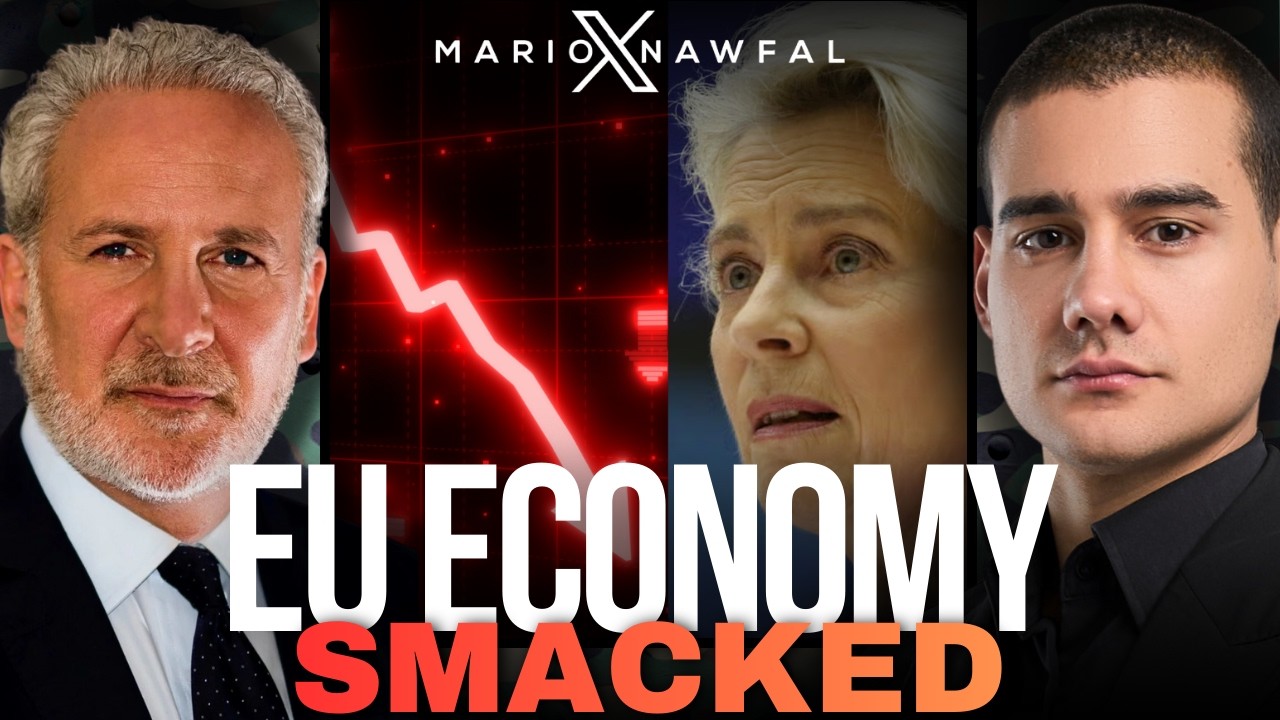
Schiff w/ Nawfal: War is an Economic Scapegoat
On Tuesday, Peter joined Mario Nawfal for a discussion about the constitutional limits on war, the likely political and economic consequences of a U.S. confrontation with Iran, and the fiscal realities that would follow. He ties those foreign-policy risks back to money and markets, warning that debt, central-bank money printing, and a weak production base make any extended conflict costly — and he closes by contrasting gold and Bitcoin as stores of value.
He begins by reminding listeners that war is not supposed to be a unilateral decision by the president, but a grave choice for the legislature to make:
All wars need to be declared by Congress. I’ve always been opposed to war where the president makes a decision on their own to take the country to war. That’s clearly contradictory to the clear language of the Constitution, the intent of the framers. The idea was that war was to be a last resort. I mean, war was supposed to be avoided at all costs and if absolutely necessary, okay, we can go to war, but it was supposed to be the result of a deliberative process by Congress.
He reads the president’s stated goals as essentially a plan for regime change, which by definition is a wartime objective:
But if you look at what Trump has said about his goals, his objectives with what’s happening with Iran, he wants to completely obliterate the entire government. He wants to destroy all of their military capability and he wants to allow the people of Iran to select an entirely new government from the one that they have now. Right? So he wants to get rid of the government, get rid of the military. That sounds like war to me, right?
That political framing, Peter warns, creates an obvious incentive: a president can use a conflict as a scapegoat for economic trouble that may have been inevitable anyway, such as recessions or higher inflation:
Number one, Trump gets a scapegoat because a lot of problems that were going to happen anyway with the economy can now be blamed on the war. Hey, look, everything was great, but you know, we had to go to war and you know, what are the sacrifices of war? Sometimes you have a recession, you have higher inflation. So it’s not my fault; I mean, everything was going to be great.
He also highlights the tight link between fiscal policy, central-bank money printing, and the global demand for the dollar — all of which determine whether the U.S. can quietly finance a conflict or will face harsher consequences, such as a possible run on the dollar:
As long as we can keep going into debt and, you know, we can sustain it as long as we can keep borrowing money. But the problem is if the Fed has to print all the money and we have a lot of inflation, can we sustain that if we have a run on the dollar, if the world doesn’t want to finance it? Over the last couple of days, the dollar has rallied. And if the dollar stays strong, that makes it easier for us to afford to finance the war.
Beyond the financing question, he presses on practicality and the human costs: bombing alone rarely solves problems, ground forces and occupation raise the stakes, and regime change can produce worse outcomes than the status quo:
I don’t know how we do that just with dropping bombs. I don’t know how we do that without sending troops on the ground. And how long is that going to take? And then the problem is, let’s assume we completely get rid of the current government and just leave it up to the Iranian people to pick another government; how do we know they don’t pick one even worse?
Shifting from geopolitics to sound money, Peter wraps up by noting that gold has outperformed Bitcoin recently and explains why his debate with CZ focused on tokenized gold rather than a straight metal-versus-crypto contest:
Well, you know, gold has gained a lot of ground relative to Bitcoin over the last few months since I had that debate with CZ. But, you know, the purpose of my CZ debate was not really to debate Bitcoin versus gold, although, you know, he tried to turn it into a, you know, Bitcoin-gold debate. But I was there to debate Bitcoin versus tokenized gold, because I think tokenized gold actually solves the main problems that Bitcoin is trying to solve only a lot better.
For more of Peter’s analysis of tokenized gold, check out his latest interview with Kitco News!

 Live Chat
 Email:
  Phone: 1-888-465-3160