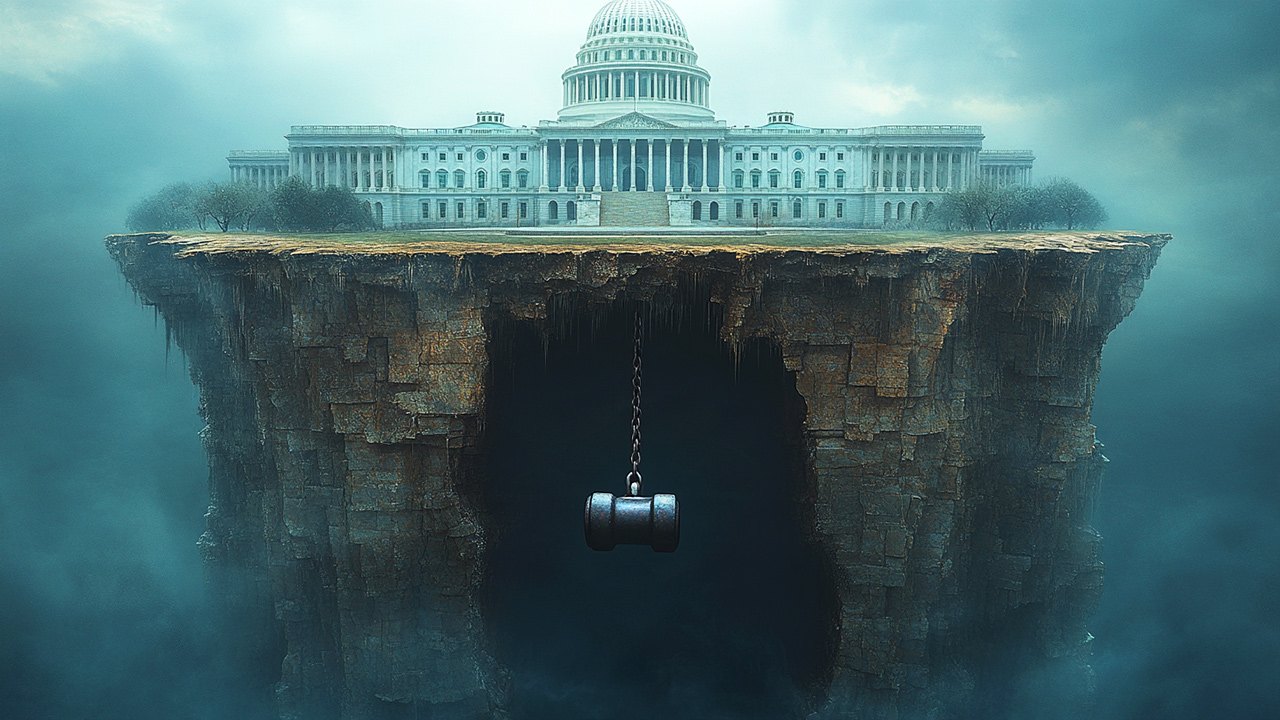
The Fed vs. the Bond Market
The economy is bound to eventually reach a point where it can no longer tolerate the interest rates required to keep inflation and debt under control, and some of the loudest warnings are coming from the bond market.
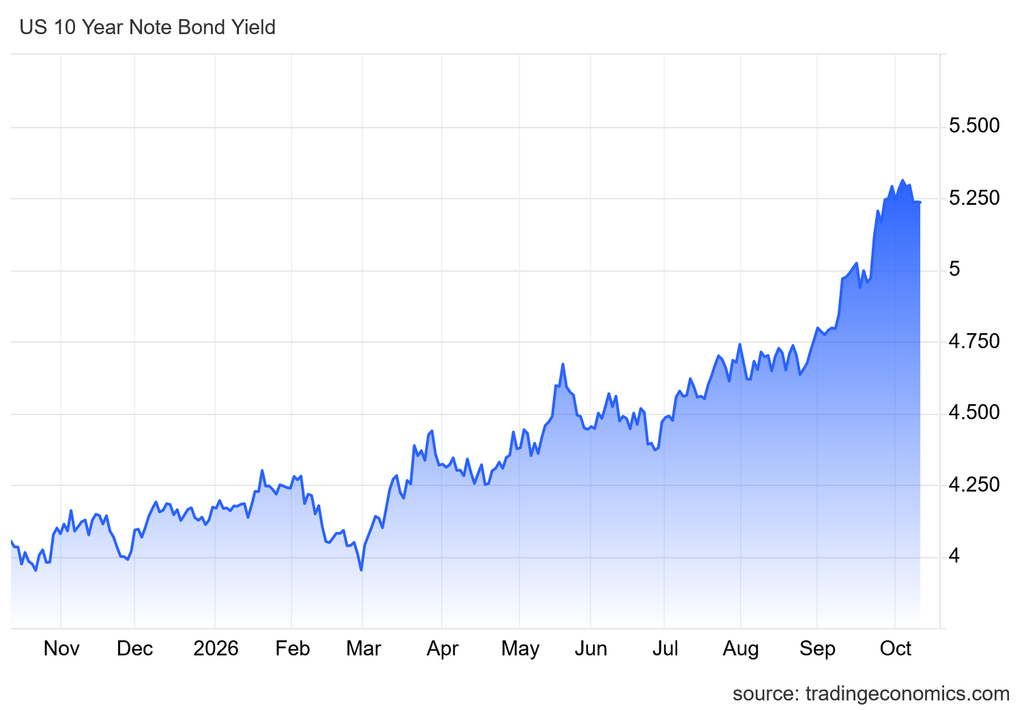
The benchmark 10-year Treasury yield recently climbed above 5.3%, reaching levels not seen since 2002. Even more striking, this surge occurred as evidence was building up of a weakening labor market, not because investors suddenly became convinced that the American economy was entering a new era of extraordinary real growth.
A rising 10-year yield is normally associated with a healthy economy. Strong growth can produce stronger demand for capital, while rising inflation expectations can lead investors to demand higher nominal returns. But when long-term yields continue rising while economic data deteriorate, the interpretation changes.
Instead of “America’s economy is getting stronger,” the bond market is saying, “America is becoming more expensive to finance.”
The Federal Reserve raised its benchmark interest-rate target by another quarter point in September, bringing the federal funds target to 3.75%-4%. The Fed acknowledged that economic activity remained solid, but it also said without ambiguity that inflation remained elevated; something that was already obvious to millions of Americans who see their dollars buying less seemingly every year.
Inflation hasn’t returned to the Federal Reserve’s 2% objective. The PCE price index was up 3.4% year-over-year in August.
The Fed is backed into a corner by a problem that can’t be solved with monetary policy. If it keeps rates high or raises them further, it puts additional pressure on households, businesses, housing and financial markets. If it cuts rates aggressively, it risks allowing inflation to become entrenched. And the 10-year Treasury is increasingly refusing to cooperate with the idea that the Fed can simply dictate the cost of long-term money.
The Federal Reserve controls the overnight policy rate, but can’t ultimately control the price at which the government can borrow for ten or thirty years. Those rates are determined in the enormous global bond market, and that bond market is demanding considerably more compensation.
The September employment report showed an increase in unemployment as previous estimates were revised downward. July’s payroll figure was revised from a gain of 21,000 to a loss of 10,000, while August was revised from 162,000 to 133,000. The combined revision reduced previously-reported employment by 60,000 jobs. That isn’t a healthy labor market, and revisions always show a clearer (and less rosy) picture after the economy has already digested the initial numbers. The first number makes the headlines, and the revision comes later.
Average monthly payroll growth over the previous twelve months was only 45,000 as of September. That isn’t the labor-market boom one would expect to see supporting a 5%-plus long-term Treasury yield.
US 10-Year Treasury Yield
Americans are spending because the economy is still functioning, but they’re also spending in an environment where prices remain much higher than they were before the inflation surge. They’re also taking on more debt for basic expenses. Household debt (excluding housing debt) has gone from $3.4 trillion in 2016 to about $5.2 trillion today.
The American consumer can maintain spending for quite a while by reducing savings, increasing borrowing, or drawing down accumulated wealth, but that isn’t the same thing as sustainably increasing purchasing power.
A 5%-plus Treasury yield filters through the financial system in the form of higher mortgage rates, more expensive corporate financing, pricier auto loans, and higher corporate refinancing costs, including in commercial real estate. The interest expense on the debt also increases, and that number surpassed one trillion last summer.
The economy is being squeezed from both directions because prices are elevated while the cost of money keeps rising. When debt levels were lower and interest rates were close to zero, the government could borrow more money without immediately feeling the full burden. However, at just a 1% interest rate, financing $40 trillion of debt implies roughly $400 billion in annual interest expense. At 5%, it implies roughly $2 trillion.
And unlike discretionary government spending, interest expense can’t be eliminated because politicians dislike it. Existing debt has to be serviced, and maturing debt has to be refinanced. This creates the possibility of a dangerous feedback loop. The obvious temptation if the government can’t tolerate 5%, 6%, or 7% long-term interest rates is for the Fed to step in and purchase Treasury securities, pushing yields back down.
But the Fed purchases assets by creating bank reserves. If the Fed’s intervention becomes sufficiently large, it can increase liquidity and ultimately undermine confidence in the purchasing power of the currency. In other words, the government faces an uncomfortable choice: Allow interest rates to rise and risk a debt-driven economic contraction, or suppress rates and increase inflation, which they’ve already admitted they’re struggling to control.
That’s why the 10-year Treasury is more important than the latest stock-market rally, the latest GDP headline, or even the latest jobs report. It’s the market’s continuously updated assessment of what investors require to lend the United States money for a decade. The economy can’t handle that required return rising too high, too fast, for too long.
The economy doesn’t really collapse because data is “too hot” in the sense that the economy is too strong. The core issue is that the financial system has become too dependent on cheap money. For years, ultra-low interest rates encouraged borrowing, speculation, high asset valuations and enormous government deficits. The endgame is a bond market crash and currency crisis unlike anything the U.S. has seen.
The 10-year Treasury is less like a thermometer measuring economic strength and more like a stress gauge measuring the cost of maintaining the existing economic structure. A 5.3% yield wouldn’t ordinarily be catastrophic, but 5.3% in an economy carrying enormous public and private debts, persistent inflation, slowing employment growth and massive ongoing Treasury borrowing is a very serious problem.
It’s less about the economy being strong, and more about the world discovering just how expensive it has become to maintain the appearance of strength. If the bond market demands a higher price, someone has to pay it.

 Live Chat
 Email:
  Phone: 1-888-465-3160